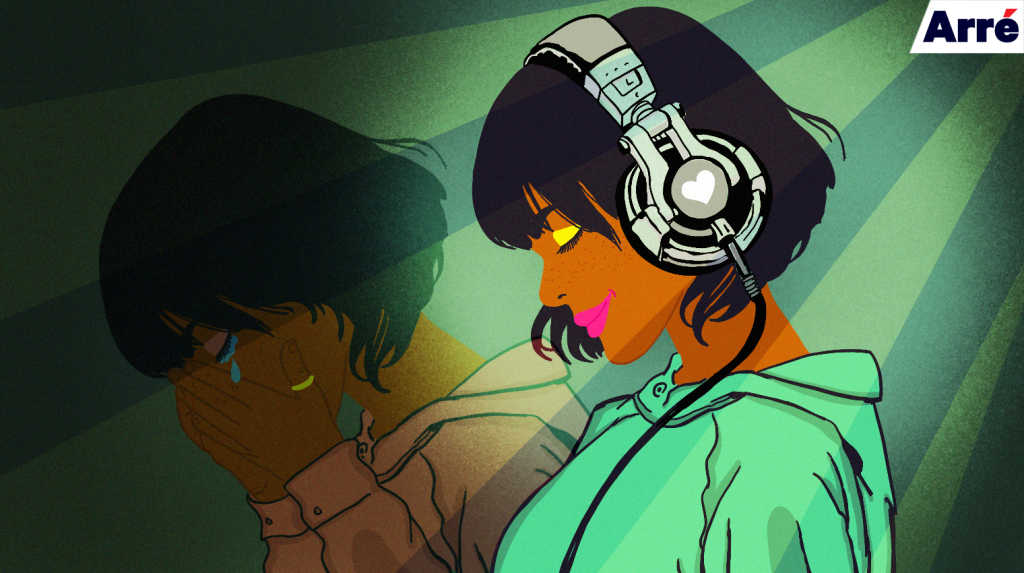

What was worse was that the memories of the night would come back to haunt me each time I was left alone with my thoughts. I often turned to music, especially Rahman, during moments of distress. But now Rahman reminded me of that fight and the violence. The music that I took refuge in had turned into a trigger. Every time I listened to Rahman I recoiled. You always think of music as cathartic. But among survivors of violence, it is common to stop listening to songs, watching films, or recreating certain experiences because of their association with traumatic memories. Objects, sounds, visuals, smells that have no traumatic nature of their own often set off survivors because of their coincidental association with trauma. It is extremely difficult when things which are meant to comfort you join the plethora of triggers. It feels like the list of places you could take refuge in keeps on shrinking. Psychologists have studied the relation between music and memories extensively. A study titled “The neural architecture of music-evoked autobiographical memories”, published in the renowned Neuroscience journal Cerebral Cortex in 2009, stated that while conducting brain mapping of participants listening to music, specific brain regions associated with autobiographical memory were found to be stimulated by familiar music. Petr Janata, the author of the study and Associate Professor of Psychology at UC Davis explains, “What seems to happen is that a piece of familiar music serves as a soundtrack for a mental movie that starts playing in our head. It calls back memories of a particular person or place, and you might all of a sudden see that person’s face in your mind’s eye. Now we can see the association between those two things — the music and the memories.” This aspect of music’s impact on brain is used in treating music as therapy for diseases like dementia and Alzheimer’s but similarly can act as a trigger to bring back the memories of trauma associated with the music. Seeing my struggle to forget what happened, my therapist made a particularly strange suggestion. Instead of forgetting, she asked me if I could revisit the memory. But she didn’t want me to recall the incident as a victim, but as an external observer, a third person present at the scene.Love, my former partner, and Rahman’s music were inseparable to my mind.
It wasn’t easy, and it took several sessions, but her advice was the beginning of an interesting process. Slowly, I started looking at all the violence I had been subject to as an external observer, and for the first time in my life, I didn’t blame myself. I felt sorry for myself, and I put the blame where it was due – on the abusers. And with it, came the sudden overwhelming feeling of self-love. I did not know I had that much love left in me, or that I could dispense it for myself. It took me a few months to start listening to Rahman again, but I did. I worked hard to understand that though my ex was the one to bring Rahman into my life, they weren’t the same. I saw them as the same because I thought of him and only him as the physical embodiment of love in my life. He wasn’t. Rahman indeed meant love, and that love was embodied in me and whoever I wanted to see it in. Eventually I severed all contact with the man who abused me. I started reconnecting with people who were supportive of me, who appreciated my presence in their lives, people who did not treat me as a cash dispenser. I also fell in love — conditional love — on Tinder. And every now and then I sing Rahman to my partner. “Dil to aakhir dil hai na, Meethi si mushkil hai na?” Rahman means love to me, once again.I felt sorry for myself, and I put the blame where it was due – on the abusers.