
A
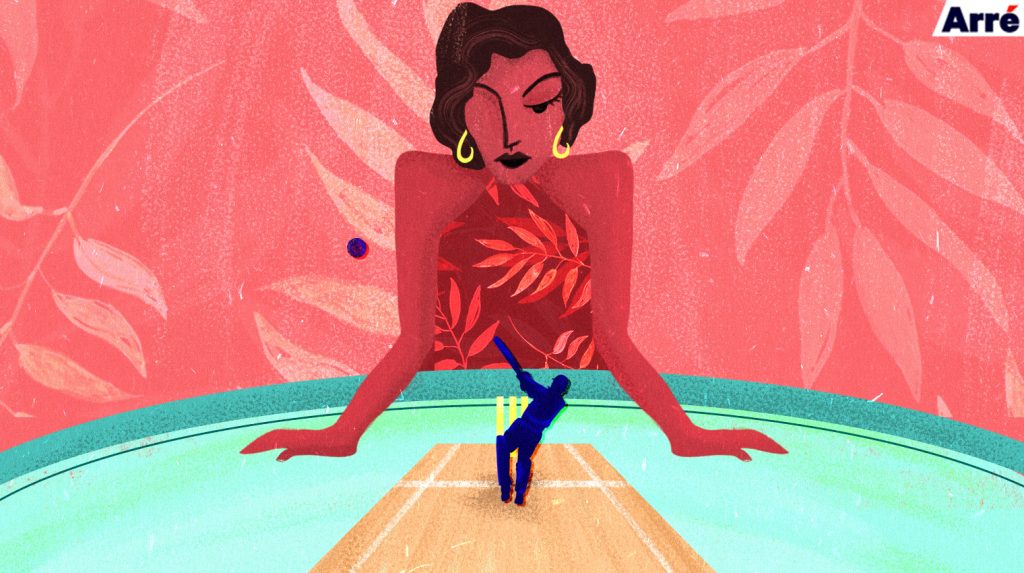
cross the pavilion end of the cricket field is the Broadcast Control Room or the BCR – the hub, the nerve centre. If the 40,000-capacity crowd forms the heart of the spectacle that is a cricket game, then the BCR is the brain. The men seated in this cramped, overcrowded space, control how millions view a single game on television. And among all the men, you’ll usually find a woman, every strand of hair in place, make-up on point, impeccably dressed in an outfit guaranteed to draw attention.
She watches the many screens in front of her, while simultaneously jotting down pointers on the tablet on her lap. “We’ve asked for Paul Burns after the game,” her producer tells her, “should definitely talk to him about the niggle that he had during the season, his opening stand, and the rapport he shares with Naman Sharma…” The well-dressed woman nods and chips in, “Playing under Viraj Malhotra and his captaincy, they were teammates last year in the other franchise too right?” Yes, the producer tells her, “And of course, ask him about support from his family, his wife…”
The Indian Premier League is a melting pot where high-profile cricketers, dreamy-eyed teenage sensations, anxious team owners, overzealous broadcasters, and glamorous WAGs – wives and girlfriends of the players – congregate annually to celebrate a sport consumed by millions. It’s an arena dominated by men, from players, to the support staff, on-ground volunteers, to broadcasters and the “expert panel” of commentators.
In this testosterone-filled environment, the women stand out. Especially since there aren’t too many of us.
A few women commentators were introduced in the IPL about a couple of seasons ago. I can count the number of female producers, presenters, production managers, and crew members on my fingers. Each travelling crew barely has five women, out of around 50 that include the director, commentary producer, vision mixer, and camera persons.
The scrutiny though, is the closest on the women who interact with cricketers. A scrutiny I’m only all too familiar with, having been a sports journalist for more than a decade.
But first, the WAGs.
For the distant viewer, sitting in front of a screen at home, the life of a cricketer’s partner can appear to be charmed – pampered in the best hotels, with nothing much to do except plan their outfit for a match and cheer for the team. Few realise just how difficult it is to be a cricketer’s partner off the field.
The wives are the players’ safety net – the one person the cricketer comes back to after a terrible or terrific day on the field.
Getty Images
Our careers are driven by cricket, and the level of trust and comfort we can achieve with the player. If the cricketer bares his heart to his partner off the field, he bares his mind to some of us producers – but trusts only a few. It’s tough work, especially when you are new on the scene, and have to abide by the unspoken rules of the professional world. You have to deflect the low-key sexual harassment – the flirtatious advances, late-night calls in your hotel room, WhatsApp messages – to stay in the game. If a woman journalist survives all this, there is a chance that over time, a bond will develop between her and the cricketer, who ends up sharing a lot of his fears about the game, his skills, and his career with the producer. She is, in a sense, his confidante too. It’s a delicate balance to maintain as with any form of reporting: Without the trust, no cricketer will open up to a journalist. But get too close, and it hampers your objectivity. When the tough questions come, some players fail to understand the difference between personal and professional relationships. We’ve seen it all: From being told not to ask certain questions, to players stopping an interview mid-way and re-doing it (after making sure that the offending clip is deleted). And even then, no matter how hard she works, a woman journalist or producer isn’t done fighting stereotypes. There is always that constant, nagging reiteration that you are, after all, a woman involved in a sport that is largely dominated by men. The workload remains just the same for us – a woman producer still needs to prep as hard as any male counterpart for the game a day prior. She spends hours shooting team practices and interviews, scripting, overseeing edits, building run orders for the shows, briefing her anchor and male colleagues in the Production Control Room who will be aiding her with graphics and visual inputs. Come match day, she’s on top of things, instructing every member in the PCR on what is next and guiding the anchor through the show flow. And it’s never really good enough. There is a constant pressure to keep proving yourself. If I had a rupee for every time I’ve been called arrogant just for taking charge or pulling up a male colleague in the PCR over an error, I’d be a rich woman today. My male colleagues, on the other hand, are termed assertive for doing the exact same thing. I suppose there is no other way for us except to keep doing a lot more to reaffirm our rightful place in this sport. I know it’s the same for those across the boundary lines too. Each of us women fighting a stereotype, working just as hard, to continue being a part of the gentleman’s game.There is always that constant, nagging reiteration that you are, after all, a woman involved in a sport that is largely dominated by men.