
T
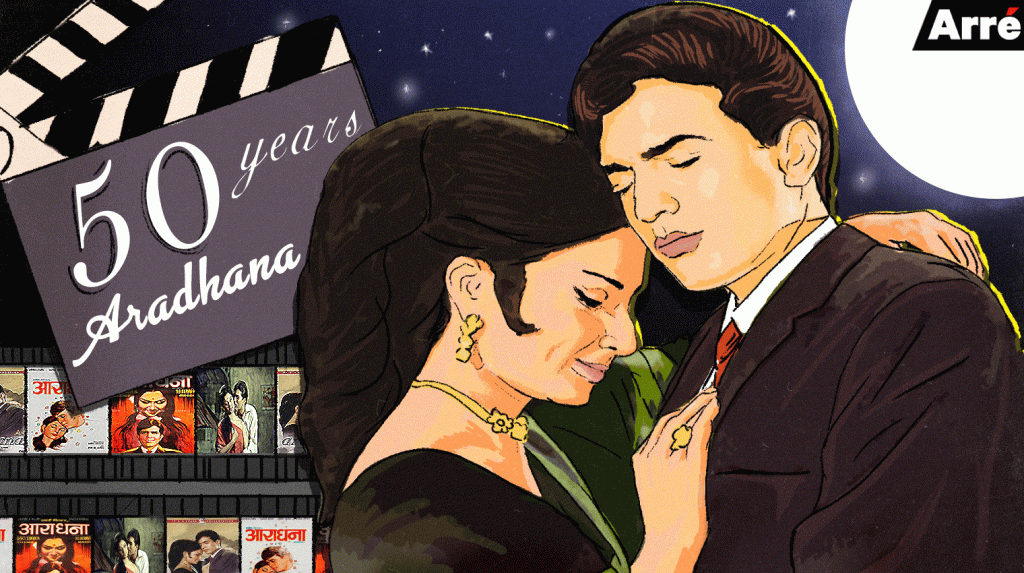
 Aradhana, a story that spans two generations, follows the journey of Vandana Tripathi (Sharmila Tagore), a dimple-cheeked beauty who falls in love with Arun Verma (Rajesh Khanna), a pilot in the Indian Air Force.
Shakti Films
Aradhana, a story that spans two generations, follows the journey of Vandana Tripathi (Sharmila Tagore), a dimple-cheeked beauty who falls in love with Arun Verma (Rajesh Khanna), a pilot in the Indian Air Force. As the two decide to marry (they even have a secret wedding in a local temple), tragedy strikes: Arun is killed in a plane crash. A heartbroken and pregnant Vandana is not accepted by Arun’s family. As fate would have it, she has to let go of her child when a rich couple decides to adopt him, and is imprisoned for 14 years after she accepts the blame for the murder of her molester, committed by her son. She returns an old woman, only to discover that her son, Suraj Prasad Saxena (also played by Rajesh Khanna) is now an Air Force pilot. The film ends on a happy note as Suraj recognises Vandana as his real mother and her lifelong aradhana (worship) bears fruit.
On the surface, Aradhana might seem like yet another run-of-the-mill film about a self-sacrificing woman’s willingness to lead a life in the shadows and suffer, only to ensure that those she loves are safe and happy. However, Samanta did much more than that. He gave us a gritty heroine, who might seem vulnerable, but is actually someone who holds her own, has astonishing emotional strength, and is unapologetic about her decisions. There is no doubt in her mind when she decides to give birth to a child conceived out of wedlock. Even when life deals her a very unfair hand and nothing seems to go her way, Vandana has a no regrets. She leads a life full of dignity and grace, even if it is behind bars. It wouldn’t be wrong to say that Vandana is a modern-day Sita, strong and silent. And this time, she even gets her due.
Since Aradhana, many things have changed around us. India thinks different, women’s rights are part of everyday conversations, but what hasn’t changed is the stigma around premarital sex, unwed mothers, adoption, and single motherhood. With Aradhana, Samanta brought to the mainstream all these taboo topics and attempted to show that although not the norm these aren’t something to be demonised either. The pre-marital sex is preceeded by a quasi-wedding, something Arun is quick to remind Vandana of when she starts to feel guilty.
Aradhana, a story that spans two generations, follows the journey of Vandana Tripathi (Sharmila Tagore), a dimple-cheeked beauty who falls in love with Arun Verma (Rajesh Khanna), a pilot in the Indian Air Force.
Shakti Films
Aradhana, a story that spans two generations, follows the journey of Vandana Tripathi (Sharmila Tagore), a dimple-cheeked beauty who falls in love with Arun Verma (Rajesh Khanna), a pilot in the Indian Air Force. As the two decide to marry (they even have a secret wedding in a local temple), tragedy strikes: Arun is killed in a plane crash. A heartbroken and pregnant Vandana is not accepted by Arun’s family. As fate would have it, she has to let go of her child when a rich couple decides to adopt him, and is imprisoned for 14 years after she accepts the blame for the murder of her molester, committed by her son. She returns an old woman, only to discover that her son, Suraj Prasad Saxena (also played by Rajesh Khanna) is now an Air Force pilot. The film ends on a happy note as Suraj recognises Vandana as his real mother and her lifelong aradhana (worship) bears fruit.
On the surface, Aradhana might seem like yet another run-of-the-mill film about a self-sacrificing woman’s willingness to lead a life in the shadows and suffer, only to ensure that those she loves are safe and happy. However, Samanta did much more than that. He gave us a gritty heroine, who might seem vulnerable, but is actually someone who holds her own, has astonishing emotional strength, and is unapologetic about her decisions. There is no doubt in her mind when she decides to give birth to a child conceived out of wedlock. Even when life deals her a very unfair hand and nothing seems to go her way, Vandana has a no regrets. She leads a life full of dignity and grace, even if it is behind bars. It wouldn’t be wrong to say that Vandana is a modern-day Sita, strong and silent. And this time, she even gets her due.
Since Aradhana, many things have changed around us. India thinks different, women’s rights are part of everyday conversations, but what hasn’t changed is the stigma around premarital sex, unwed mothers, adoption, and single motherhood. With Aradhana, Samanta brought to the mainstream all these taboo topics and attempted to show that although not the norm these aren’t something to be demonised either. The pre-marital sex is preceeded by a quasi-wedding, something Arun is quick to remind Vandana of when she starts to feel guilty.
With Aradhana, Samanta brought to the mainstream all these taboo topics and attempted to show that although not the norm these aren’t something to be demonised either.The real beauty of Aradhana then lies in the delicate balance it maintains, the fact that it tips to no one side. There is no outright disregard for social norms and conventions and neither is there complete adherence. In her own way, Vandana too manages to strike a balance between trying to live by the rules and being her own person. She understands that being a child of an unwed/single mother will have its own consequences, so she chooses to let Suraj grow up in a home with his adoptive parents. In her pursuit of a dignified life, Vandana is not alone. Samanta provides her a whole network of support – people who didn’t use social rules to judge her. The one person who stands by her through most of her struggle is also the man most likely to throw a fit – her father, Gopal Tripathi (Pahari Sanyal). Not only does he encourage his daughter to do what makes her happy – including promptly saying yes to being with the man she loves – but he also respects her decision of wanting to not abort and lead a life as a single mother. In a country where fathers killed their daughters and continue to do so for “ghar ki izzat”, to show an unconventional father, five decades ago, was commendable. In all of Aradhana’s melodrama, there are moments where Vandana is severely judged for her choices and a man even tries to take advantage of her vulnerability, implying that because she’s “alone”, she is available. The film is not perfect in any way – it has its flaws and weak moments – but it is sincere. By giving us a world that rises above societal restrictions and sees a woman for who she is, coupled with her own strength and determination, Samanta gave us a film that is relevant even 50 years later and will continue to be for many decades to come.