
I
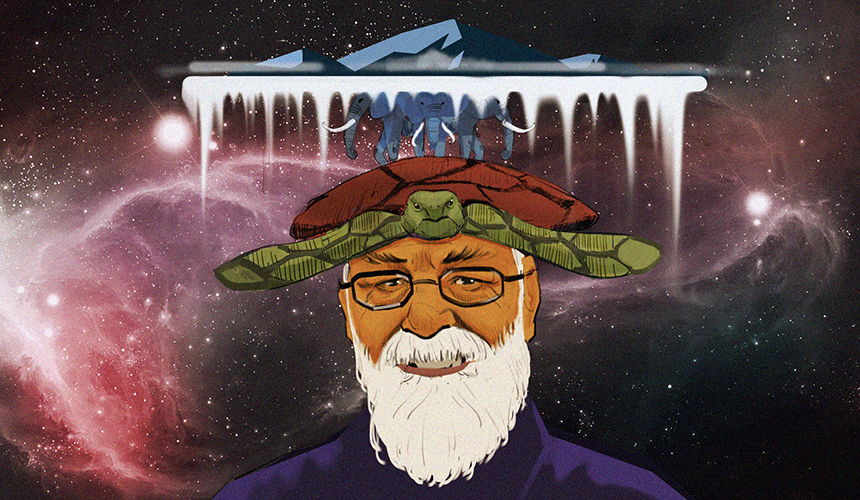
n 2016, Chetan Bhagat’s pandering editorial on the need to build a Ram Mandir at the spot where Babri Masjid once stood was rewarded. The author secured a spot in Delhi University’s English literature syllabus. His novel, Five Point Someone: What not to do at IIT!, was included in the “popular fiction” category, while actual writers like Amitav Ghosh and Rabindranath Tagore were dropped to accommodate him. This seemed to be the government’s way of saying that even if you aren’t a complete square and have endured parental and societal pressure to study the arts, you should know more about the IITs. Of course, all of this was couched in talk of updating the university syllabus to reflect current authors. But really, if the contention was that arts students were reading outmoded literature, then may I put forth a humble suggestion? Today, on what would have been the author’s 70th birthday, I argue – with the authority of a former literature student and all-round fan boy – that Terry Pratchett, the author of the Discworld series, should be included in that syllabus. For the uninitiated, Discworld is an imagined universe: A flat disc spins on the backs of four elephants that stand on a giant turtle flying through space. The universe is home to several characters like werewolves and vampires that are stock-in-trade for fantasy fiction. Yet, for all its grand imagery, Discworld is suspiciously similar to Earth. The real estate prices are just as high, the police officers are just as corrupt, and people are just as greedy. Even if you haven’t read the books, there is a wealth of insights and real-world truths to be gleaned off of Pratchett’s quotes alone. There’s relationship advice: “And what would humans be without love?” “RARE, said Death.” There’s counsel for Facebook warriors: “Five exclamations, the sure sign of an insane mind.” But more importantly, his writing is always relevant. Given our current dispensation’s habit of either disregarding or scorning anyone who doesn’t live by their belief system, a conversation in The Truth, a novel about journalism in Discworld, sticks out like a trishul in the bathroom. William de Worde, an editor of a newspaper, while speaking to Lord Vetinari, the Patrician of the city, says, “I’m sure we can all pull together, sir.” It’s delivered as a sincere, pacifist statement that there could hardly be an objection to. Still the Patrician replies: “Pulling together is the aim of despotism and tyranny. Free men pull in all kinds of directions.”
All it takes is one simple, light-hearted conversation for Pratchett to bombard you with the deepest insight – especially at a time when there’s a general uptick in “nationalism” and “patriotism” across the world. The Truth serves as a great reminder to not trust everything you read on the internet. “Humour fantasy” is not a genre most people tend to pick up when they want to do some serious reading. But to call Terry Pratchett a common humourist is like calling Mahatma Gandhi just a pacifist. The most famous fantasy epics, such as Lord of the Rings and the Wheel of Time, often offer satirical observations on our own universe cloaked in immensely complex storylines and character interactions. Pratchett’s satire, meanwhile, doesn’t just needle you with a point. Instead, it throws the needle away, steals a chainsaw, and shoves it into your chest before stealing your iPhone out of your back pocket. Sometimes, to have a greater understanding of our world, as the author once wrote, “It’s useful to go out of this world and see it from the perspective of another one.” This is increasingly important today as people on the internet continue to get more polarised over issues like Kim Kardashian’s bubble butt, or Salman Khan’s bubble arms, or Chetan Bhagat’s bubble brain. A Discworld character would avoid confrontation, laugh, and walk away. That’s where I found Discworld most relevant to my own life. As a child with a tendency to suffer mild anxiety attacks, I often found myself overthinking the most minor of setbacks. The smallest complication would put me in a state of immediate panic, and leave me in situations where I would often feel helpless – unable to deal with the pressure of growing up, of having responsibility, eventually make money, and have a life. Discworld, where uncomfortable situations were treated with a certain amount of levity, offered me a way out.I didn’t realise how important Terry Pratchett was to this change in my behaviour until about a year ago, when I moved back to Mumbai from Delhi and began re-reading Mort.

Terry Pratchett’s Discworld is an imagined universe: A flat disc spins on the backs of four elephants that stand on a giant turtle flying through space.
Dave Hogan / Getty