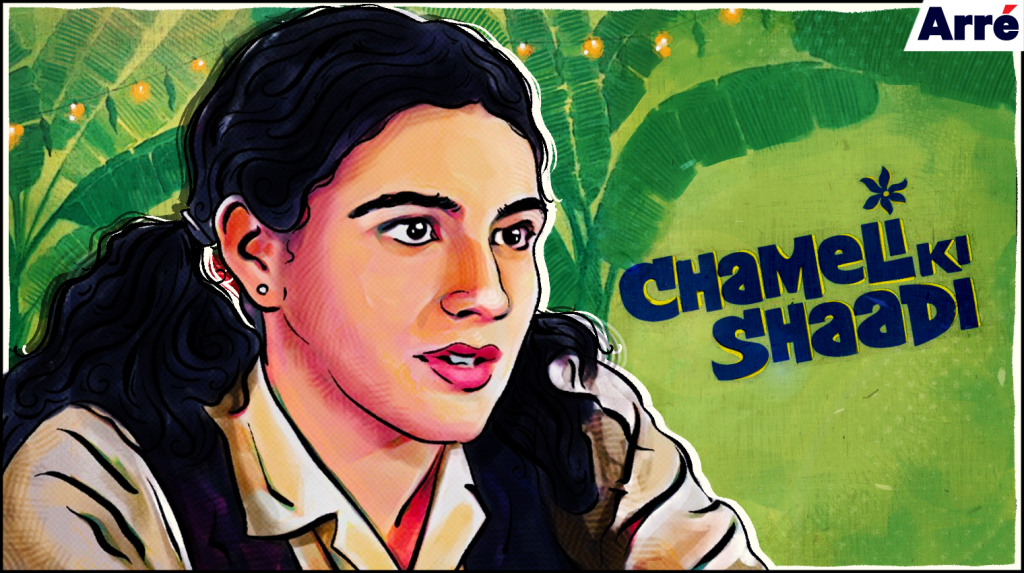

Basu Da has always given us strong heroines. Right from Baton Baton Mein’s Nancy, who refuses to bow down to anyone’s idea of how she should lead her life, to Chotti Si Baat’s Prabha, who has no qualms about taking her own path to finding the most suitable man. Even in that trend, Chameli has managed to set herself apart. She is equal parts beauty and brawn, armed with quick wit and the ability to take on any and every man. These are traits that her mother Champa (Bharati Achrekar) is forever trying to curb, but Kallumal seems to be covertly proud of the powerhouse daughter he has raised. When questioned though, he is quick to shift the “blame” to Indira Gandhi, who insisted that women should be educated. Champa’s way of dealing with her daughter’s indiscretions is simple – lock her in a room and marry her off to the next available man from their biradri (caste). In this endeavour, she is aided by her brother Chhadam Lal (Annu Kapoor), who concocts an elaborate plan of murdering Charandas. However, Chameli is no simple belle. One cannot restrain her or expect her to go down without a fight. Even in captivity, she manages to activate a solid network of friends and well-wishers who make sure she can effortlessly communicate with Charandas. Cherry-on-top is the hands-on beating Chhadam Lal receives from Chameli as soon as he tries to scare her by revealing his evil, murderous plans. This isn’t even the first beating Chameli dealt out. Nathulal (Ram Sethi) left with his own set of bruises when he came to “warn” Kallumal of his daughter’s attempts at dishonouring the family name. Charandas’s attempts at making things happen cannot be discounted. He is, after all, the one who decides to not give up at all despite having no real prospects or money. Yet it is Chameli who shines. She might have failed four times in Class 8, but she is sharp, intelligent, and goal-oriented when it comes to things she truly desires. She even manages to get a transistor from Charandas, while still locked up, so she could listen to Hindi film songs to make the separation a little less bearable. As part of punishment, Champa had confiscated her radio. In this earnest love story, the feisty, gregarious, and full of chutzpah Chameli is the perfect yin to the shy and romantic Charandas’s yang. At the onset of their romance, Chameli makes a promise of “tu jahan bhi chalega chalungi” and sincerely sees it through. In many ways, it is her stubbornness and sheer determination which ensure that the lovers are united. Chameli doesn’t wait for a change of heart or a streak of luck. She doesn’t sit around and wait for things to work out on their own. She gets out there and takes charge. Throughout the film, Chameli holds her own, even in the end when she yells at Charandas for suggesting that she gives him many “pahalwan” (wrestler) kids.Chameli is equal parts beauty and brawn, armed with quick wit and the ability to take on any and every man.
Chameli ki Shaadi’s feminism does not start and end with Chameli though. Her best friend, Anita (Rupini), is a rebel in her own right. She is both a voice of reason and unwavering support for Chameli. Even though admittedly uneducated and toeing in line with what society “expects” of women, Champa seems to be the one enjoying a stronghold in the “Koylawaala” household. She doesn’t really feel the need to consult her husband when taking decisions and neither does she ever offer any explanations for them. In a cameo role we see Jayshree T who plays Gulabo, Nathu Lal’s wife. She is absolutely unapologetic about her lifestyle and enjoys spending her time playing cards and hanging with what Chameli eloquently describes as “mohalle ke launde” (local boys). It would not be wrong to say that in Chameli, Basu da gave Bollywood a heroine much unlike any that had been seen before. She is brash, loudmouth and short-tempered, yet lovable. But you don’t ever feel like she is over-the-top. On more than one occasion, you want to throw an “attagirl” at her. On the whole, the film is a good-natured satire, littered with rib-tickling sequences and dialogues. At the core of it, it is the story of one woman’s determination and refusal to bow down to society, and how she effects a change. It is implied that the Chameli and Charandas wedding led to a string of “biradri ke bahar” (inter-caste) weddings. Thirty-five years on, Chameli ki Shaadi has not lost even a smidge of its magic.On more than one occasion, you want to throw an “attagirl” at Chameli.