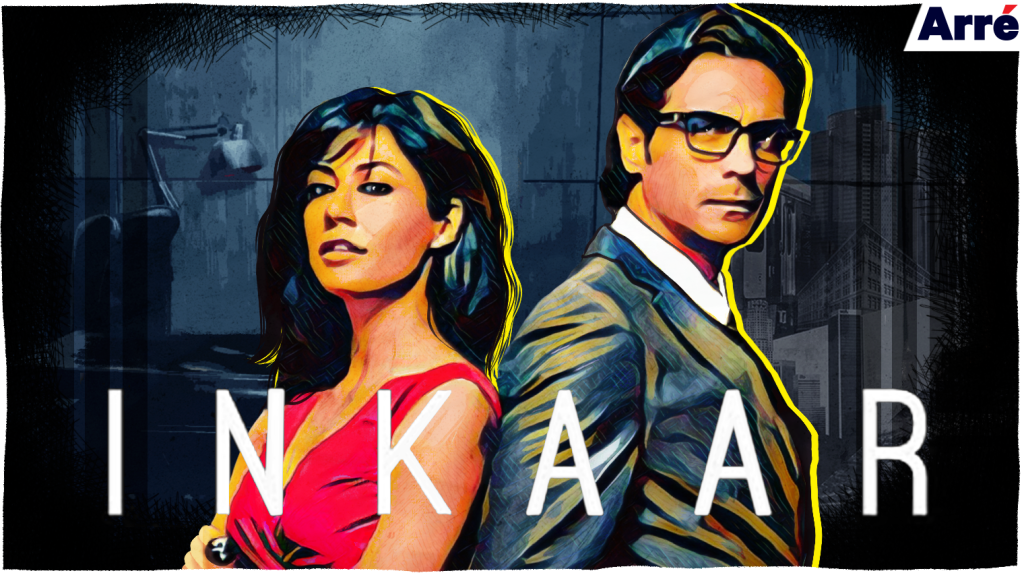

In the entire sequence leading to Maya being ostracised by her colleagues, Inkaar highlights a key feature of twisted power dynamic and gender politics: That while organisations may encourage women employees to speak up, when push comes to shove, people shall protect their own interests first and conveniently side with where the power lies. And it is quite easy for the powerful alpha-males to get away with their problematic behaviour in the name of casual mischief – particularly in an industry where the supposedly creative minds require to be set free of corporate code in order to flourish. The film, however, refrains from taking the easy route of painting its men as inherently evil. In fact, there are facets in Rahul’s version of events that merit due consideration. In his head, Rahul has perhaps only been flirtatious with Maya and given their history, feels he is entitled to taking some occasional romantic liberties. His behaviour, while often problematic, does not stem from a place of malice. And this is the grey area where harassment often becomes impossible to define. Is a person simply meaning no harm enough to pass off as acceptable behaviour? Does presuming consent to offend constitute harassment? When is the line crossed? There are no simple answers to these questions and Inkaar does not pretend to know better. The events leading up to Maya finally lodging a formal complaint against Rahul are endlessly revisited in the film. In the process, many inconsistencies and even an odd bit of insincerity in both the narratives are exposed. But Inkaar seldom takes the investigative path aiming to uncover the truth from a web of lies. Its focus instead firmly remains set on highlighting the complexities of relationships. Two attractive people working long hours in close vicinity may inevitably lead to them surpassing the professional boundaries. But the power differential remains the underlying force that determines the nature of such relationships. Maya is both attracted and intimidated by the relentlessly charming Rahul. Beyond a point, she finds it beyond her to resist his sly advances, not that she is repelled by the idea. It is also not like the obvious career benefits of getting involved with Rahul had never dawned on her. But the film quite succinctly draws the point home that despite what Rahul may now feel was an arrangement Maya fed off, it does not entitle him to obnoxious behaviour. And that consent once lent cannot simply be taken for granted at convenience. However, the film’s most important takeaway perhaps is that not once has Rahul sexually violated Maya’s boundaries. And yet, his toxicity and the resultant emotional trauma that she has had to undergo does legitimately constitute harassment. The discourse on safe workspaces in the Indian society is still nowhere near refined enough despite the shockwaves that India’s 2018 #MeToo movement sent across industries. In fact, one of the most high-profile cases to have come out during the time involved senior journalist- turned-politician MJ Akbar. Priya Ramani, a former subordinate of Akbar, accused him of sexual harassment post which several other women shared similar experiences with him.Unlike rape or sexual assault, workplace harassment is often impossible to coherently describe in words that would resonate with ordinary people.
A little over two years later, Ramani continues to fight a defamation suit filed against her whereas Akbar has had to lose little since having to resign as Minister of State in the aftermath of the allegations. He still remains a parliamentarian and has more or less started being normalised. But to little surprise, there were plenty in the media fraternity who wrote sly apologias for Akbar conveniently shifting the blame to the “tone and tenor” of the #MeToo movement. This is very much in keeping with the phenomenon explored in Inkaar where the powerful never run short of influential friends to bat for them while the victim gets systematically cornered. In 2013, another celebrity journalist Tarun Tejpal had been accused of sexual assault by a former colleague. In his defence, Tejpal acknowledged the incident but insisted it was a “misreading of situation” on his part. A few months later, Manu Joseph wrote an elaborate piece for the Outlook magazine, which was a little shy of shaming the victim in so many words. And even so many years later, the discourse still remains fairly rooted into the medieval mindset of dishonouring the victim by finding fault in their accounts rather than actively holding the accused to an answer. This week completes eight years since Inkaar released and went largely unnoticed. And though our understanding of a subject as sensitive as workplace harassment is unlikely to evolve any time soon, the film could certainly do with some retrospective appreciation.Does presuming consent to offend constitute harassment?