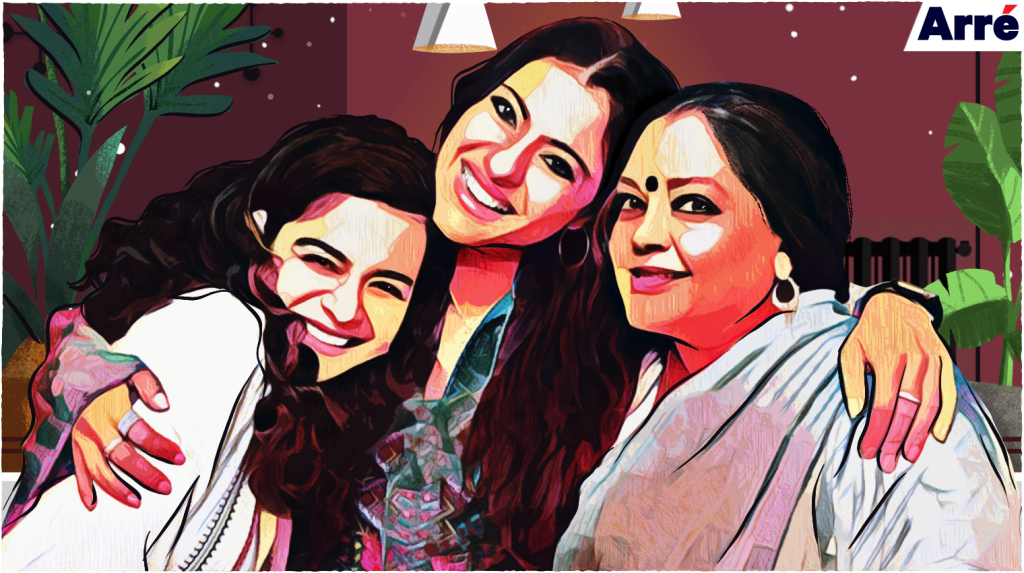

That moment reminded me of my mother’s many sighs and silences. The passive-aggressiveness and violence in her pauses and inflections, placed strategically and executed with flawless precision for maximum emotional devastation, without even one unpleasant word being exchanged. It’s a language that, I believe, women are particularly skilled at… In a world that often goes to extraordinary lengths to silence us, we have to be. Tribhanga and Shahane do a fine job of whetting your appetite for such moments of spectacular emotional depth and sincerity… And then leave you frustratedly hanging. Sigh. If I had to sum up the movie in one sentence, I’d call it an incomplete collection of quietly stirring scenes — the one where Anu realises that after a lifetime of trying not to, she’s gone and done exactly what she most blames her mother for — stitched together with far too many drenched-in-nostalgia ones that, though bittersweet, never quite reach their intended destination. Delightful as Kajol is as the mercurial Anu — angry, abusive, vulnerable, strong, stormy, and sensitive, all within seconds of each other — I wish Shahane hadn’t allowed Kajol’s stardom to dominate a story that had the potential to be India’s Lady Bird. The movie belongs too much to Anu, not enough to Nayan, and far, far too little to Masha, Anu’s traditional-as-they-come daughter played by Mithila Palkar. And minus the all-important context and POVs of the two generations that bracket her own, Anu’s character often looks like it’s simply floating around aimlessly — in turns growling at her mother’s biographer Milan (Kunaal Roy Kapoor), reminiscing with her Krishna-devotee younger brother Robindro (Vaibhav Tatwawaadi), and generally being a don’t-mess-with-me badass.Tribhanga and Shahane do a fine job of whetting your appetite for such moments of spectacular emotional depth and sincerity…
In the 36 hours since watching Tribhanga, I’ve recommended it to several close women friends despite its agonising flaws, simply for its arresting central premise. So many of us have travelled the path Nayan, Anu, and Masha are walking on. Confident in our abilities to make better, different, more authentic choices than the ones made by our own mothers. Filled with youthful arrogance that crumbles to horrified dust in middle age, when we realise we’re a lot more like our mothers than we ever intended to be. The tension between the self-loathing and relief that accompanies the realisation that our identities will always be tethered to our mothers in some unfathomable, invisible ways. Always needy for their approval. Aware of their mortality and the rapid march of time, while so much has been left unsaid, and terrified that the clock will run out before we work up the courage to form the words bristling in our breasts. Many of our mothers received suspicious no-reason-I-just-wanted-to-hear-your-voice middle-of-the-day calls after watching the film. Just for that, Team Tribhanga, take a bow.Filled with youthful arrogance that crumbles to horrified dust in middle age, when we realise we’re a lot more like our mothers than we ever intended to be.