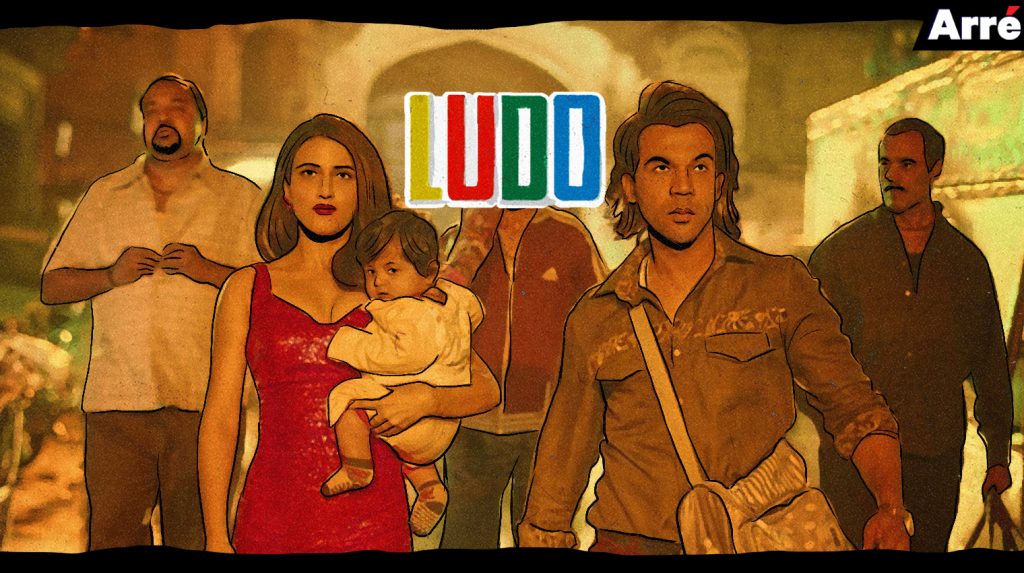

And yet, Basu can’t help but indulge himself: Every moment is crammed with a lifetime worth of backstory, references (a reference to Coronavirus is made early on in the film for no reason other than it can be made), and unnecessary complications that derail from the purpose of the film. With every plot escalation, it becomes clear that Ludo is the kind of film invested in the eventual destination, a climactic moment where these protagonists will convene under one roof and face their conscience by confronting each other. Their journeys, excessively labyrinthian and sluggish, feel like a means to an end. It’s difficult to not get the sense that Basu (credited for story, screenplay, cinematography, and production design) worked backwards to serve the film’s ending, ensuring that the pieces of the puzzle fit. The lack of interest shows in the narrative where events occur, but don’t drive the plot. It doesn’t help that Basu falls back on his trusted storytelling device of the voiceover to compensate for characterisation, explaining emotions rather than their origins. This puts the viewer at a considerable distance from not only the proceedings but also the protagonists. Riddled with imperfections Essayed by an eclectic ensemble cast of Rajkummar Rao, Abhishek Bachchan, Sanya Malhotra, Fatima Sana Sheikh, Aditya Roy Kapur, the film is marked with inconsistent performances that draw a blank for the most part, with the exception of Rao and Tripathi (both of whom have played similar characters in the past) whose physically alert turns offer a peek into the film that Ludo could have been.With every plot escalation, it becomes clear that Ludo is the kind of film invested in the eventual destination.
Even when Basu’s films have been riddled with imperfections, there has always been a distinct energy in the filmmaking that is difficult not to be swayed by. Ludo feels like a step down in that direction. The writing consistently devolves into cliches. For instance, Basu’s interpretation of one-sided love feels like it is in need of an update, as does his idea of violence (subdued women suddenly take to guns right during the climax). The moments in the film, which runs at a sluggish 159 minutes, that really sing – a suspicious wife following her husband wearing a nightie, or an old, injured don being shut into submission by the aggression of an otherwise caring nurse – are few and far between. At one point, Basu as the film’s narrator, tells his much-younger companion matter-of-factly, “Do you want a straight answer for a tricky question?” That pretty much sums up the film’s intentions. Yet, you can’t help but wish Anurag Basu didn’t make every question look trickier than it should be.The lack of interest shows in the narrative where events occur, but don’t drive the plot.