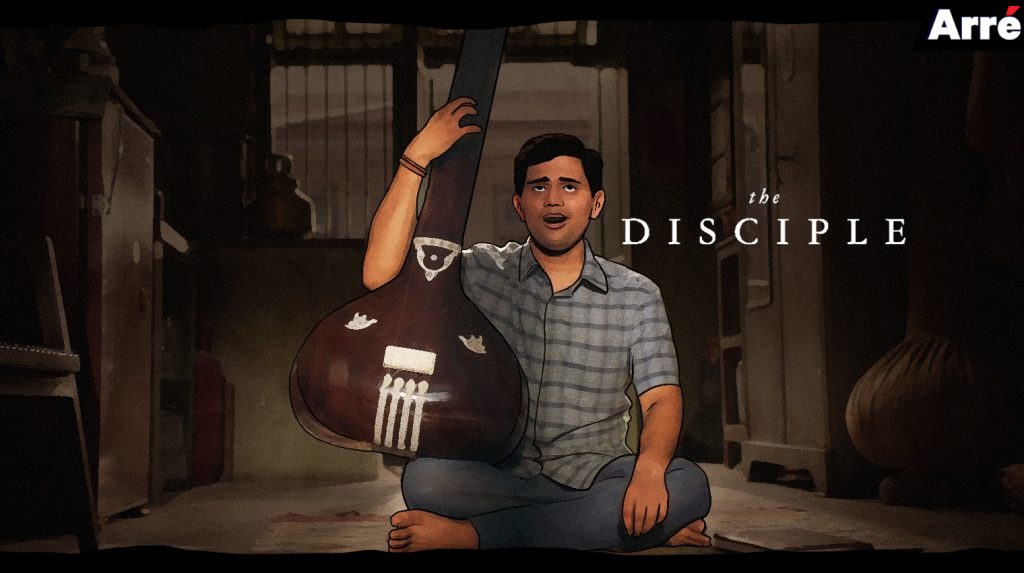

Not only is Oscar-winning filmmaker Alfonso Cuarón its Executive Producer, The Disciple became the first Indian film to play in competition at Venice International Film Festival since Mira Nair’s Monsoon Wedding won the Golden Lion in 2001. As of last weekend, the film snagged the FIPRESCI Jury Award as well as the Best Screenplay award at the festival. For anyone wondering: the breathless adulation surrounding the film is completely justified. Spanning across three decades, The Disciple immerses the viewer in the intoxicating, unexposed world of Hindustani classical music with a razor-focused clarity, examining the interplay of the relationships between teacher and disciple, art and artist, and the artist and his audience. It opens in 2006 when Sharad’s routine involves a monk-like commitment to perfecting the nuances of “Khayal,” where the singer must be in total control of his psychological state. An all-consuming, rigorous quest, meant only for the select few who succeed in remaining untouched by worldly distractions. Under the uncompromising tutelage of his Guruji (played by 76-year-old musician Arun Dravid, a disciple of the late Kishori Amonkar), Sharad considers himself up for the challenge. Tamhane refuses to underline whether Sharad is actually passionate about classical music or if he embraces it only to overwrite his father’s failure, a man who was unable to transcend the difference between artist and genius. While this is an approach that initially feels frustrating, it later adds a rich layer to its flawless conclusion. Sharad’s life is spartan: An ageing grandmother, a drab job selling CDs of obscure classical musicians, and no inclination for companionship. He remains dutiful only toward proving himself as a musical force to reckon with, listening to philosophical audio lectures from Maai (voiced by National Award-winning Marathi filmmaker Sumitra Bhave), the guru who taught his mentor, as he bikes across Mumbai at night. The price of being an artist The Disciple’s central conflict is in the dissonance between the theory of art and the reality checks provided by its actual practice – in this case, the mythology surrounding classical music that elevates it from a career to a form of higher calling. Maai’s advice for the younger generation willing to tread on this “eternal quest” is to not care about the audience. But this proves to be easier said than done for an art form whose intended effect is incomplete without reactions from an audience. Sharad constantly searches for this admiration – in peers, audiences, students, and judges mid-performance. The scenes where he displays anger and helplessness toward his own shortcomings that are relayed to him by disagreeable YouTube comments and his mentor’s blunt criticisms, are the film’s most potent indictment of the amount of life that art can suss out of an artist. Throughout the 120-minute runtime, Tamhane masterfully builds a case about the reception of art being as integral to the language of artistic fulfillment as its creation, with his trademark unhurried approach.The Disciple is a sweeping existentialist tale of a disillusioned artist questioning his art.
If The Disciple, a film that contains numerous grand themes rarely loses sight of both its journey and destination, it’s solely because of how Tamhane plays with the rhythms of form. The film largely makes use of static wide shots, filmed at a remove from the proceedings and their stillness heightens the intensity of Sharad’s simmering internal conflict. The Disciple unfolds equally through the suggestions of its meticulous framing (the ethereal cinematography is by Michal Sobocinski) as it does through its plot. There are also the sub-plots that inform the narrative without forcing their way into the proceedings – a thread about the commercialisation of classical music that runs parallel to Sharad’s artistic discontentment and ultimately leads to his placid climactic outburst is haunting, for instance. Yet, the filmmaker’s vision of an artist coming to realise that he might have devoted his entire life to an altogether outdated, if not meaningless, pursuit wouldn’t have been half as compelling if not for Modak’s inimitable lead turn. Without missing a single beat, he delivers a performance, equal parts vulnerable and inert, that encompasses the dualities of an entire lifetime. “Art” is the stories we make around it; the meaning we place on it. In The Disciple, Tamhane urges the viewer to also consider the human cost of maintaining that grand illusion, of the lives delayed in their search for a kind of perfection that might not exist anymore.The Disciple ’s central conflict is in the dissonance between the theory of art and the reality checks provided by its actual practice.