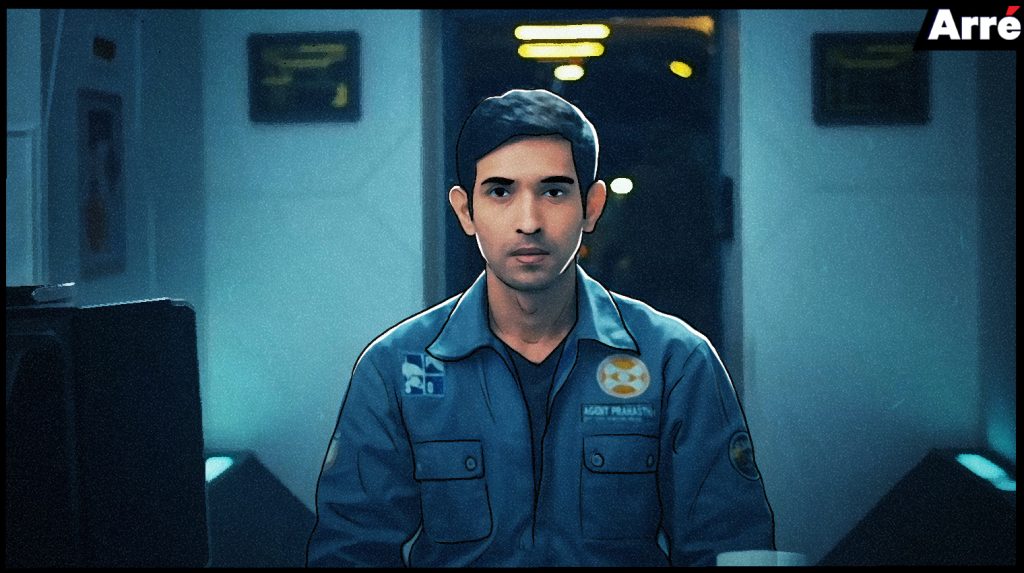

A familiar tale rendered strange But what differentiates Kadav’s vision is the film’s cultural ingenuity. The solitude of space is universal, and by now, a familiar tale (Gravity, Ad Astra, Moon, Solaris, The Martian). Kadav, who makes her writing and directorial debut is aware of that and instead, defines the emotional core of Cargo in the specificity of its world-building. The universe of space in this movie is unlike any other; it is rooted inherently in the homegrown grammar of Indian mythology. For instance, the astronauts manning the spaceships are ageless demons who are exactly like humans, except that they each have a superpower. Prahastha is himself named after the chief commander of Ravana’s army and his demon supervisors mirror the indolence of the innumerable sarkari babus down on Earth. The corporatisation of death in Cargo is a family inheritance; the CEO of PDTS is related to Yama, the lord of death. A voiceover informs the viewer of an astronaut’s imminent retirement – he is named Duryodhan. Even the deadpan black comedy is underlined with impossibly Indian eccentricities: Cargo opens with a hilarious “feature presentation from Earth,” one that has an international loneliness detective (Biswapati Sarkar in an enjoyable cameo) dissuade depressed humans from killing themselves. He reminds them of the services that he can offer, which include him coming to their houses, eating their food, and sharing their bed to cure them of their loneliness. The advertisement is naturally shot on a crowded local train, the best possible confluence of secretly lonely strangers. Then, Kadav uses a kitschy reality show that plays in the background as a recurring device (apt for a voyeuristic country) to parody the inconveniences that the bizarre superpowers present in the lives of the demons and they too suffer from similar societal indignities as humans, like a rising rate of unemployment and employee strikes.Cargo, like most films about space and loneliness, is then an inverted story about the healer being in urgent need of healing.
The arrival of a unique voice in filmmaking The inventiveness of a space film like Cargo – a genre that isn’t usually embraced by Indian filmmakers, much less considered the domain of female filmmakers – doesn’t lie merely in how Kadav crafts the minutiae of the universe in a way that it is instantly recognisable and ingenious. It’s how she bypasses the assumptions and limitations of what constitutes the sci-fi genre, generally slotted as big-budget cumbersome outings. The subversions almost feel like a third protagonist and the ambition of the film is its audacity, a testament to the arrival of a truly unique filmmaking voice. In fact, the film’s casting follows that route: Both Tripathi and Massey deliver sentimental performances that are at once minimalistic and attuned to the stripped-down production design of Cargo. Just like the film, their turns aren’t as conventionally moving as you’d expect them to be, but there’s a certain conviction in how they hold back that informs the proceedings instead of burdening it. That the plot meanders after the halfway mark is but a minor hiccup, given that Kadav has chops to spare, bringing alive the frustrations of longing with such vivid tenacity that it makes the distance between connecting and isolating that much more piercing.The corporatisation of death in Cargo is a family inheritance; the CEO of PDTS is related to Yama, the lord of death.