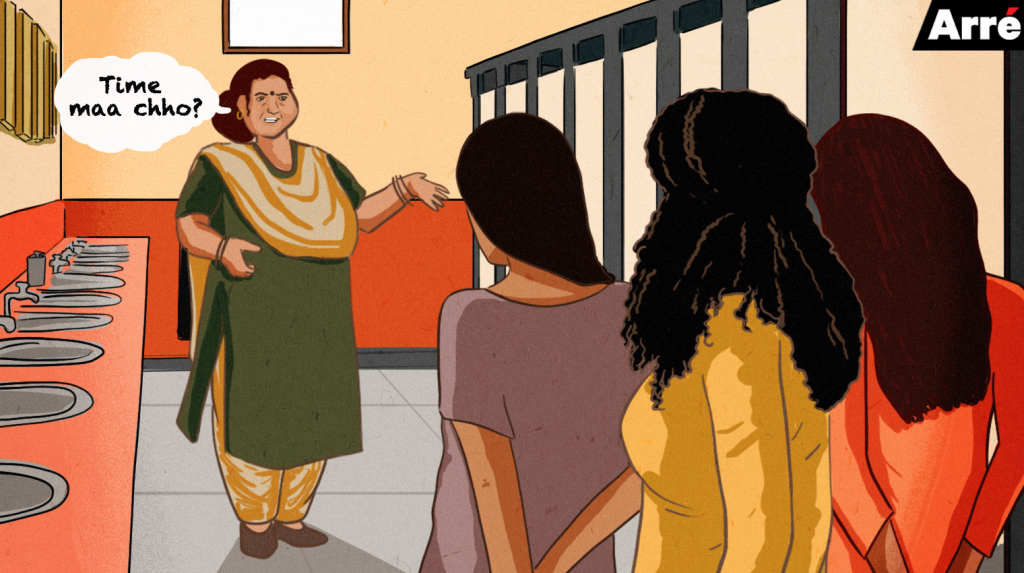

Radhika, my next-door neighbor, rang our bell a few weeks later. She didn’t say a word in greeting, but simply gestured to accompany her to her bedroom. Too bewildered, I followed only to be pointed at her cupboard. I opened its wooden doors, took out a set of crisp salwar kameez, a pair of undergarments, and a dupatta. Then she pointed at one of her bedside drawers from which I took out a pair of gold earrings. “Sab zameen pe rakh do,” I was finally told. I barely recovered from the absurdity when she very soberly informed me that nobody was home and her “time” had started abruptly, so she could not touch anything. I suggested that she actually could, as no one had to know what she did in an empty house. But she kept shaking her head and said, “Paap chadega.” The next day I watched in disbelief as Radhika flung the car keys to her husband near the common stairs. He couldn’t let their fingers brush against each other, of course. In peak winters, I cringed as Parul, my Sindhi friend, slept on the floor of her bedroom with a special mattress just for the occasion. Her mother-in-law told me haughtily, “These women have it better than us. We were given a separate room and just a bedsheet as that’s easy to clean. These women at least get to sleep in their rooms.” Another night, at a friend’s home, their teenage daughter brought in all the snacks and tea from the kitchen because the mother was on her period. I later found out their meals were also being cooked by the daughter on those days. When the daughter had her period, it was her mother who bore the brunt. If sitting on the floor when guests visit is humiliating, imagine your dinner and lunch being placed on the ground while the family eats on the table. I was once asked to move away from the tulsi plant while standing at a friend’s balcony. That was the day I decided never to share with anyone when I was bleeding and that has been my coping mechanism ever since.I gift the book Menstrupedia to the daughters of my friends in the hopes their parents may read it too.
Shockingly, the higher up on the societal ladder one is, the more afraid one is of “upsetting the gods and goddesses” by allowing impure women about in their own homes. Here men don’t feign ignorance about the subject. They know exactly what it is and treat the women as untouchables because years of conditioning have told them so. Scarily, it is the women who discriminate the most, and again it is their social conditioning, with a little bit of “I had to go through this, so you should too” thrown in. In the imbroglio, never does the discomfort and pain of the women in question ever arise. In fact, women pop pills to postpone their period if there is a wedding or a puja in the house. Given all the financial smartness of the communities that cohabit this state, one would think that basic scientific knowledge would have trickled down to humanitarian aspects too. But the fact is that while they want your wombs to bear children (read: sons), they don’t want your blood on their carpets. I keep attempting to push the limits in the city I now call home. I gift the book Menstrupedia to the daughters of my friends in the hopes their parents may read it too. I keep having discussions with the elder ladies about how no goddess would want this for her girl child, that by making “our time” everyone’s business, we aren’t becoming practical, we are just feeding an old monster. This isn’t the way we tell our sons and husbands about menstruation; this is further alienating them and widening the divide between the sexes. That this subject is taboo is just the tip of the iceberg. The layers of indignity that accompany a phenomenon as natural and healthy as menstruation is mind-numbing. The humiliation cuts across castes and financial classes, education notwithstanding. Recently my friends were all taking turns to hold my baby, and when it came to a 15-year-old, she shrugged and said she couldn’t. I knew that face all too well. I insisted she hold the baby and when she did, it felt like indignity of many years evaporating. It’s a small step – but a relevant one.I greeted the bahu but she said “na na, time maa chhu” to ward my handshake off.