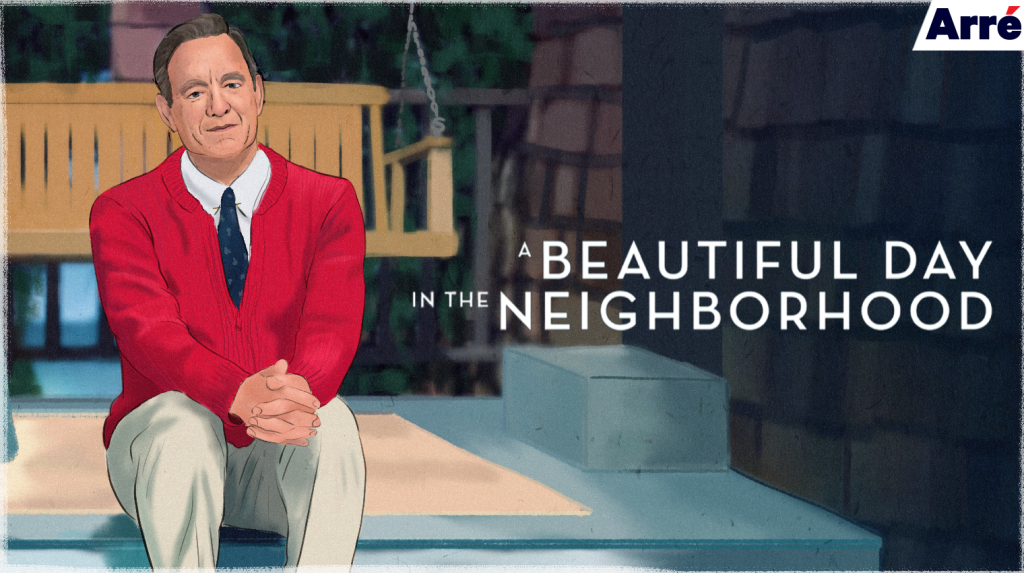

A Beautiful Day in the Neighbourhood is a gentle drama about the burdens that men quietly carry around in their hearts.Unlike last year’s Mister Rogers documentary Won’t You Be My Neighbour? that offered an irresistible, illuminating peek into the TV host’s personal life, Heller isn’t fixated with viewing Fred Rogers as a mystery that needs to be solved. Instead, Heller, complemented by a pitch perfect Tom Hanks performance (the casting doesn’t get more poetic) welcomes the curiosity about the man behind Mister Rogers. It helps that Hanks plays Rogers without wanting to decipher him as if ensuring that the inner complexities of Rogers, whose whole life is otherwise fair game as public memorabilia, is afforded a semblance of privacy. The sincerity is oddly touching. What Heller is interested in mapping is the extent of his influence, especially on adults, through a tender tale of redemption. The result is a mesmerising, emotionally intelligent portrait of the blurring lines between masculinity and art. A Beautiful Day in a Neighbourhood opens with a daring opening sequence which is a thing of marvel – exactly how Mister Rogers began his show, down to the same rectangular format. In a carefully recreated set, Hanks performs the transformation of becoming Fred Rogers in real time as he opens the door to his world of neighbourhood make-believe and lets us in. He takes off a blue blazer and shoes without breaking eye contact with the camera and while singing the show’s hummable title track before donning the signature red zip-up cardigan and sneakers.

I was almost breathless at the sincerity with which Hanks performs a mundane ritual of playing with his shoes for a moment after taking them off.
Sony Pictures
A Beautiful Day in the Neighbourhood goes in unbelievable directions that sparkle with inventiveness.It’s almost as if Heller anticipates the response to the straightforward narrative. Perhaps, that is why, even when the story unfolds exactly as you think it will, A Beautiful Day in the Neighbourhood goes in unbelievable directions that sparkle with inventiveness. For one, Heller adeptly plays with the form of the film. It operates in a surreal universe that merges fantasy and reality in a way that often seems like a hallucination, in the same way that Llyod remarks that Mister Rogers doesn’t feel like a real person. There’s a dream sequence that is fable-like in its composition. It’s stacked with smart flourishes, whether it is narrative devices that seamlessly substitute location shots with miniature cityscapes or in the juxtaposition of Roger’s unvarnished compassion for children with the enduring relevance of his beliefs in the real world. Yet, I’d be inclined to argue that the real charms of the film lie in its subtext. If in Can You Ever Forgive Me?, Heller interrogated the boundaries of authenticity in art, here she prods the cost of an artist sustaining his humanity. It’s an intimate recreation of the very definition of artistry – a commitment to a state of grace. This ambitious vision reaches its crescendo in the melancholic closing sequence, where Mister Rogers familiar to a world that might not come close to really seeing him, plays the piano signalling the end of a day of a shoot. There’s a moment where he jams down hard on the keys, revealing a deep hurt simmering inside him. That Heller only hints at it, feels like an act of almost maternal preservation; either way it’s a moment that makes a masterpiece out of a cliffhanger. After a point, A Beautiful Day in the Neighbourhood starts resembling Mister Rogers, capturing precisely what it must have felt to live through a time when a man on the TV moved you enough to care, to believe in something, and want to be his neighbour. I can’t stop thinking about a captivating moment where Fred Rogers says, “I want to look through the camera into the eyes of a single child” to Llyod on the phone exactly when he looks out of his window to see his father waiting downstairs for his forgiveness. It’s in this scene that you realise the simplicity of Heller’s deception: She intended for us to look with Mister Rogers and not at him. The point of view was always going to be that of a child. More importantly, the film’s investment was always in translating the empathy of Mister Rogers for a world that could do with some of it. It’s never not a beautiful day in the neighborhood for that.