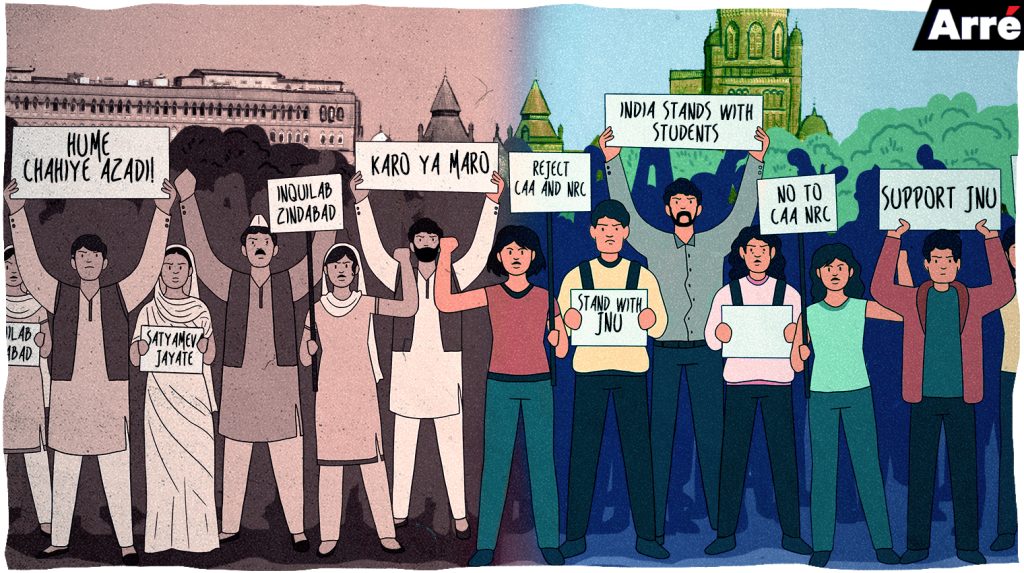

Hordes of Mumbaikars walked with me from Grant Road station to August Kranti Maidan. It felt as though the protest had already begun — at least, the sloganeering already had. What’s usually a 10-minute walk took over 25 minutes because of the pedestrian traffic. The incessant sound of horns made way for chants of “Azadi”. Some protesters were smiling, others looked more determined. I, meanwhile, was nearly moved to tears by the sight of lakhs of people who, like me, knew something had to be done that day. I was not alone. Eventually, I never made it into the protest ground. But that did not matter. The streets were a spectacle in themselves. With rousing political speeches, groups of young students holding creative signs, and protesters handing out sweets and bottles of water, the streets had turned into the freedom party I had always expected my grandfather to describe to me. August 15, 1947, was in my head always this — a celebration of our solidarity, our anger, our hopes, our prayers, and more than anything else, our togetherness. As the sun set, I started my walk back to Grant Road station with the rest of the protesters. There wasn’t an inch of free space to be seen on the streets, the walkways, the overhead bridges, or the trains. But rather than make me want to run in the other direction, which large crowds usually tend to do, the sight made me smile. Once I had made it back into the train, the everydayness of life struck me again. The girl standing in front of my seat, sandwiched between five women, and carrying her backpack on her chest, fixed her makeup. In a fast moving, jam-packed local train, she slowed time ever so slightly to wing her eyeliner. I watched her, mesmerised. The mundaneness of her activity contrasted with the fact that we had just returned from taking on an iron-fisted government, stuck out like a sore thumb. I may never really know what August 15, 1947 was like. The whims of my now deceased grandfather never allowed me to hear a real first-person account. But, the last few weeks of violence and subsequent protests, have given me new ways to (re)imagine the day.The incessant sound of horns made way for chants of “Azadi”.
The urgency with which protests and solidarity meets were organised across the country, hours after a brutal attack on the students of JNU on January 5, is telling of the resistance that has been building up over the last few years. Protesters mobilised at the Gateway of India two hours after the attack, and went on for 48 hours, while other cities like Pune and Hyderabad joined in the following day. From AMU to NLSIU Bengaluru, from FTII to Jadavpur University, students, teachers and parents have been burning the midnight oil to stand in solidarity with the JNU students. Protesters from all walks of life — unionists, activists, artists, and even celebrities — have broken their silence and made their rage known. This diversity is best seen in the “It’s gotten so bad, even XX is here” posters and memes that have been doing the rounds for the last few weeks. Political conversations have seeped into every household, and even occasionally feature in Instagram stories of the most superficial beauty bloggers. All these events have made me reconsider my initial thoughts about August 15, 1947. Maybe, rather than being the electrifying public event that I had expected it to be, it was this underlying feeling of hope in the air that my grandfather was unable to articulate. Maybe it was this sense of solidarity across religious and class lines that made the day so special, rather than an out of the ordinary spectacle. People ask, “Why protest? What impact does it have? Nothing will change anyway.” Perhaps it won’t. But as we sit and absorb the horrors around us, we must learn to find ways of knowing true tragedy and still survive, and maybe, just maybe thrive. Like Lin-Manuel Miranda says, “You cannot let all the world’s tragedies into your heart… But the ones you do let in should count. Let them manifest action.”People ask, “Why protest? What impact does it have? Nothing will change anyway.”