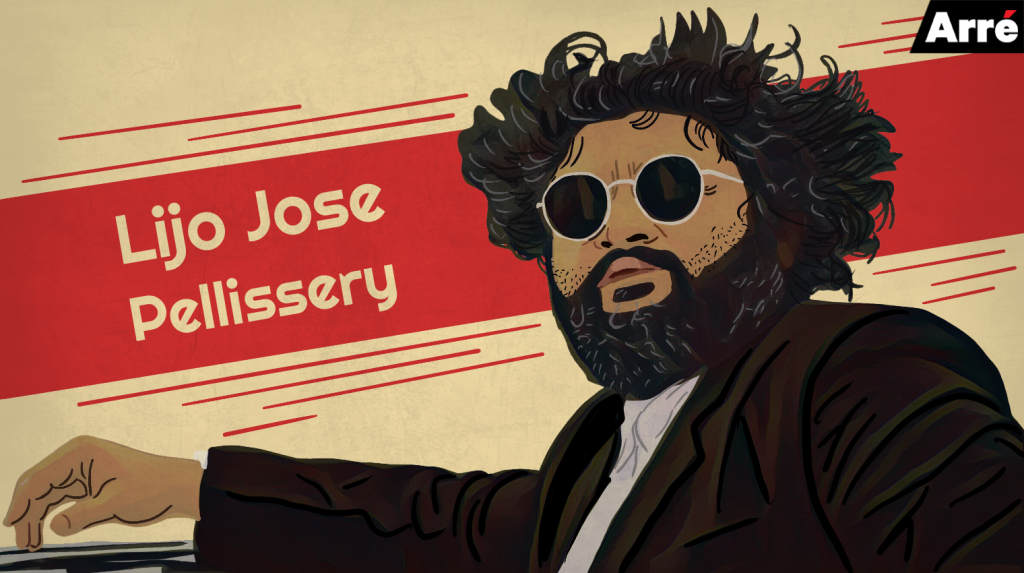

Tracing how Pellissery came to be a force to be reckoned with, is impossible without unpacking the faults of Double Barrel. Despite starring Prithviraj, Indrajith, and Tamil actor Arya, it was a misfire to beat all misfires and an experiment to beat all experiments: pretty much dead on arrival. Prithviraj, who co-produced the film, even took to Facebook to warn the audience that the movie was something new for Malayalam cinema to witness and that they must go with an open mind. A hodgepodge of genres, Double Barrel took its cues from American grindhouse and was laced with over-the-top performances, pulpy aesthetics, and a funky screenplay, that never quite settles into coherence. Prithviraj’s plea seemed to make it clear that it was one of those films where the cast had a lot of fun filming it but they failed to realise that their joy never translated on screen. Looking back, 2015 might have been too soon for Pellissery to make a gamble. Despite its resounding rejection, Double Barrel is invoked today, not because it was ahead of its time (it remains as unwatchable as ever), but because of the seminal film it led to and who Pellissery eventually turned into. How exactly did someone who resorted so easily to gimmicks rein himself in? How did a filmmaker who dabbled in mixing genres learn to ration his excesses and focus on characters as a single entity, building a consistent mood? The answer might lie in revisiting a long-standing tenet of Malayalam cinema that was lost in the intervening years of the late 90s and the noughties. As the 2010s rolled in, Malayalam cinema chose to become star-driven, celebrating actors purely for their demigod status. But that changed in a couple of years when the industry left the past to die, even killed it willingly, to use Kylo Ren’s advice from The Last Jedi. The control was back with the filmmaker. Pellissery recognised this earlier than anyone: he let go of his mainstays like Prithviraj and Indrajith, and as a belligerent response, worked with 86 debutantes in his next film – Angamaly Diaries. I could be theorosing but it’s clear as day that Angamaly Diaries brought forth a more free Pellissery, who started focusing less on people and more on their way of life. It might also have something to do with the writers he collaborated with – Chemban Vinod Jose, novelists PF Mathews, and S Hareesh – whose body of work lends itself to Pellissery’s focus on the collective as an entity. Almost magically, a gimmick became an honest, cinematic expression, teeming with elegance – the climax of Angamaly Diaries featured a 11-minute single take with hundreds of artistes and felt like the most organic thing in the film. Like other contemporary Malayalam filmmakers, Pellissery embraced the pluralistic society of the state that always intermingled with its neighbours more closely than others: A whole group of Tamil characters from City of God, famous Tamil songs used from Kalyanaraman’s Kadhal Vandhuruchu, to a brass band version of Ilamai Idho Idho found their way in Angamaly Diaries, arguably the filmmaker’s most popular film yet.Is it any wonder that Pellissery polished himself from a mere technician to the auteur that he is today?
A year after Angamaly Diaries, Pellissery was back with Ee Ma Yau – possibly his best film to date – that looked at a Latin Christian parish off Kochi. A funeral became the lens through which the filmmaker offered a character study of the people that inhabit the town and the grief and anger that they carry within their chests. True to tradition, the single unbroken shots, the chaotic frames, and tearful, desperate pleas to the gods above, are all here. Although elements of fantasy have been present in all of Pellisery’s films, right from Amen, in Jallikattu, his dazzling recent outing, the whole premise is a fantasy. A bull – to be slaughtered for meat – breaks loose and causes havoc in a lush town with abundant forests. The film’s lighting works to highlight these forests in which the men and the beast live together but seldom give excuses to distinguish between them. It’s eerily reminiscent of Mad Max Fury Road – all storyboard and visuals, hardly script and plot. And yet it sparkles with its set-pieces, the disorienting visuals playing mind games, even churning your stomach. In Jallikattu too, Pellissery finishes with a “how-did-they-film-this” climax. In this regard, Jalikkattu is the ultimate movie where Pellissery regulars Prashant Pillai and Renganath Ravee get to flex their muscles with abandon. In fact, in the three recent films that have brought the director nationwide fame, the duo – musician and sound designer – are as integral as the filmmaker. Jalikkattu is the antithesis of Double Barrel: A Pellissery experiment where almost every crazy gamble pays off. It might not be accurate to term the last ten years, that saw the filmmaker make seven films, as the decade of Lijo Jose Pellissery. Maybe that’s how singular directors emerge: through the persistence in their journey. Pellissery started off promisingly, showing consistent growth as well as surviving heavy thuds and refining his craft through it all. The scale and ambition of every new Pellissery film keeps expanding. It might be apt to summarise the legacy of the filmmaker through a quote from Amen that goes,”Unless you people see signs and wonders, you will never believe”. Ten years on, Lijo Jose Pellissery continues to aim for those signs and wonders.The scale and ambition of every new Pellissery film keeps expanding.