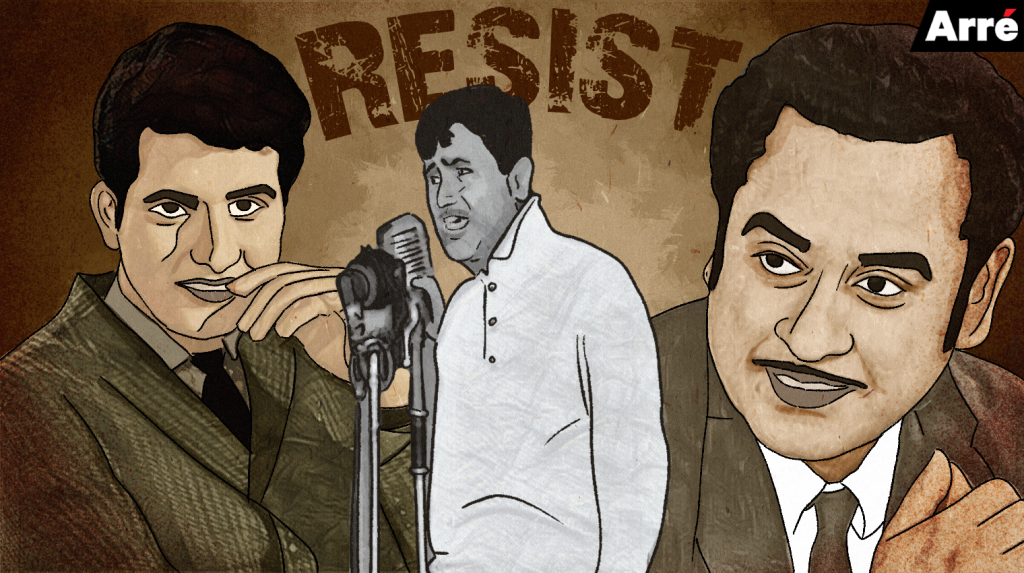

Even Dev Anand and Shatrugan Sinha were not spared when they refused to comply with the government’s diktats. Just like Kishore Kumar, Anand and Sinha’s movies were banned on Doordarshan. Anand along with his brothers, Chetan and Vijay Anand, went on to become one of the fiercest critics of the Emergency, dubbing it as an insult to the people of India. Sinha, on the other hand, was reportedly threatened that he would be implicated in the Baroda Dynamite Case if he didn’t campaign for the Congress in Bihar. Joining these actors in their dissent against the dictatorial whims of the ruling establishment were industry’s bigwigs Gulzar, Raaj Kumar, V Shantaram, Uttam Kumar, Satyajit Ray, and Danny Denzongpa. Four decades later, India is facing curbs on media, the internet has been shut down in cities amid the growing nationwide resentment and protests against the Citizenship Amendment Act and National Register for Citizens. But Bollywood seems to have forgotten its history of standing up to those in power. What makes their silence even more ironic is that these anti-CAA protests have been led largely by young students who form a massive chunk of Bollywood’s fanbase. As the police unleashed a reign of terror in the Jamia Millia Islamia University two weeks ago, several big names from Bollywood including Shah Rukh Khan, Kabir Khan and Kiran Rao – all alumni of the university –failed to utter a word expressing their solidarity for students of their alma mater. Aamir Khan, who emerged as a “Sunday morning activist” of sorts for India’s middle class with Satyamev Jayate seems to have gone into a shell after his 2015 remarks on the growing intolerance kicked off a storm. For actors who have on several occasions proudly flaunted the fact that they come from a family of freedom fighters (SRK’s father Taj Mohammed Khan had been a part of Subhash Chandra Bose’s INA and Aamir’s great grand uncle was Maulana Abul Kalam Azad), the silence is a great disservice to legacy of their illustrious ancestors.The deafening silence of Bollywood biggies can’t be chalked down to them being apolitical either.
Even the younger crop of actors, supposedly more progressive, empathetic, and outspoken than the older generation, have been no different. On one hand, Ranveer Singh, the star of Gully Boy, which adapted Kanhaiya Kumar’s epoch-making chant of “Azaadi” into its soundtrack, remained conspicuous by his silence. And on the other, Deepika Padukone, Kareena Kapoor, and Akshay Kumar have instead chosen to look the other way and continue promoting their films. The likes of Vicky Kaushal and Ayushmann Khurrana – both of whom accepted the National Award on Monday even as the death toll in Uttar Pradesh kept rising – resorted to the oldest PR trick in the book: the balancing act. Even when these actors have said something, it’s been as good as not saying anything. The select few who have been speaking out – Anurag Kashyap, Anubhav Sinha, Farhan Akhtar, Swara Bhaskar, Huma Qureshi, Parineeti Chopra, Dia Mirza, and Sushant Singh – remain in the minority. The deafening silence of Bollywood biggies can’t be chalked down to them being apolitical either. That argument surely doesn’t hold water given that several of these A-listers, who now choose to exercise their right to silence, have rushed to click selfies with PM Narendra Modi in January this year, when campaigning for the general elections were at its peak. The lack of spine in Bollywood is neither surprising nor is it new. But given our history of dissent, it is certainly disappointing. Maybe today’s actors could benefit from drawing inspiration from the actors in the ’70s, who understood that being a hero onscreen meant little if you weren’t invested in raising your voice and being a hero off-screen as well.The lack of spine in Bollywood is neither surprising nor is it new.