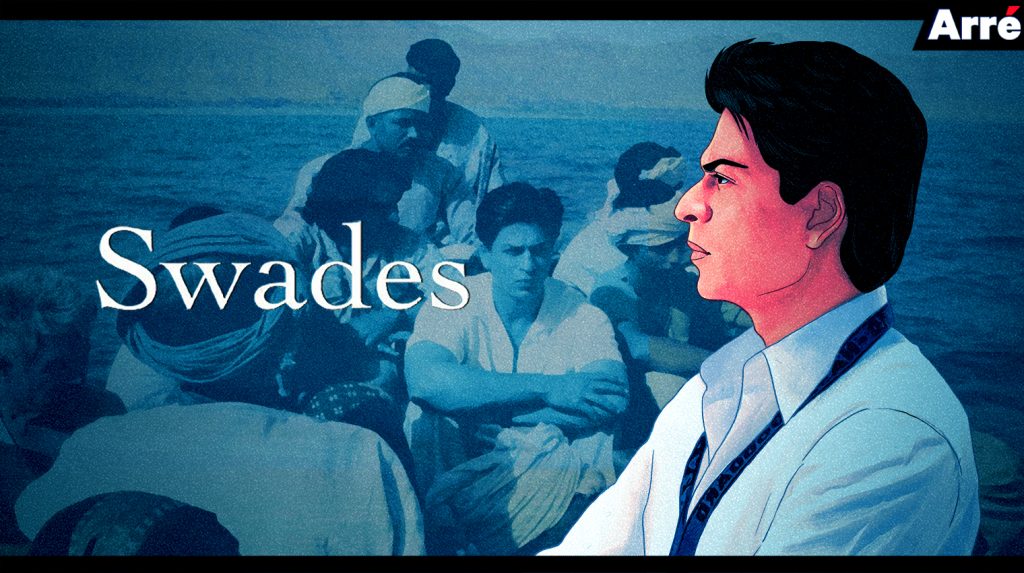


Swades showed us an alternate version, a version that started with one man’s emotional response to one person and one problem, then one more, and one more.
Ashutosh Gowariker Productions
Swades was sandwiched between other patriotism-themed movies like Mission Kashmir, Refugee, Fiza, Gadar: Ek Prem Katha, LOC Kargil, The Hero: Love Story Of A Spy. We were used to seeing our nation-loving heroes in fatigues, yelling slogans, launching grenades, firing guns… Basically doing things that made the blood roar in our ears and adrenaline course through our veins. I like to think of these movies as little ampoules of deshbhakti, to be consumed tri-annually on the Republic Day-Independence Day-Gandhi Jayanti trifecta. And suddenly, in the midst of this testosterone-fuelled party we got the anodyne Mohan Bhargava (Shah Rukh Khan) who just wanted to go back to his safe, comfortable, studious life at NASA, just with his Kaveri Amma in tow. He wasn’t drawn to India by a burning desire to change its destiny — all Mohan wanted was to locate the motherly woman he had allowed himself to neglect with as much expediency as his privilege would allow, and take her back with him. His most pressing worry, whether the bathroom in the village would have plumbing. Mohan, unlike his patriotic peers, was the kind of deshbhakt we could imagine ourselves being, some day. We can’t imagine ourselves running headfirst into enemy camps at the border, but we can imagine ourselves being moved to tears when a farmer who can barely afford to clothe his family offers the little food he has to the men who have arrived to collect rent. We can imagine ourselves weeping when a young boy who should be in school is selling chai at the station. And we can imagine ourselves feel anger bubble and spill over when the future of the country is being deprived of education due to caste and gender discrimination.What I can say with certainty is that Swades’ beauty — then, and now — lies in its simplicity.
“Jo kabhi nahi jaati, ussi ko jaati kehte hain.” (Caste is the thing that can’t be cast away) It’s what Mohan is told when he tries to advocate for equal treatment for all. It’s tragic that even today, we can still hear the echo of these sentiments. We hear it every time a Dalit student commits suicide after facing unbearable harassment at the hands of upper-caste classmates. And every time young men and women are killed in the name of family honour if they have the temerity to fall in love with someone outside their caste. Mohan’s distress and inability to comprehend the many, many fault lines that divide India are our own, as we go about lives in our little, sheltered, cosmopolitan bubbles. But then, so are his victories. I’ve seen Swades at least half a dozen times, but even now, I can’t help but let out a small whoop and wipe a tear of joy when that damned sheet separating the two castes comes down in the middle of “Yeh taara, who taara.” And every time the kids receive their textbooks — tribal kids, upper and lower caste kids, both boys and girls, I feel an indescribable warmth spread in my heart. Who is to say that setting 20 kids onto the path of education not as much of an act of patriotism as fighting a war in its name is? Swades is a movie special in its smallness. Mohan doesn’t burst onto the screen with all the pomp and circumstance of bravado. Bollywood, much like the government, has, for too long, fed us an idea of nationhood that is so much bigger than ourselves, most of us tend to struggle to understand our place in it. Swades showed us an alternate version, a version that started with one man’s emotional response to one person and one problem, then one more, and one more. Sometimes, while caught up in the frenzy of loving the idea of a country, we forget to love the people that make it what it is. In this polarised, divisive moment that we’re currently living, it’s good to be reminded, in the style of Swades, that sometimes lighting even just one bulb is enough.Mazhab, or religion, will get India every time.