
L
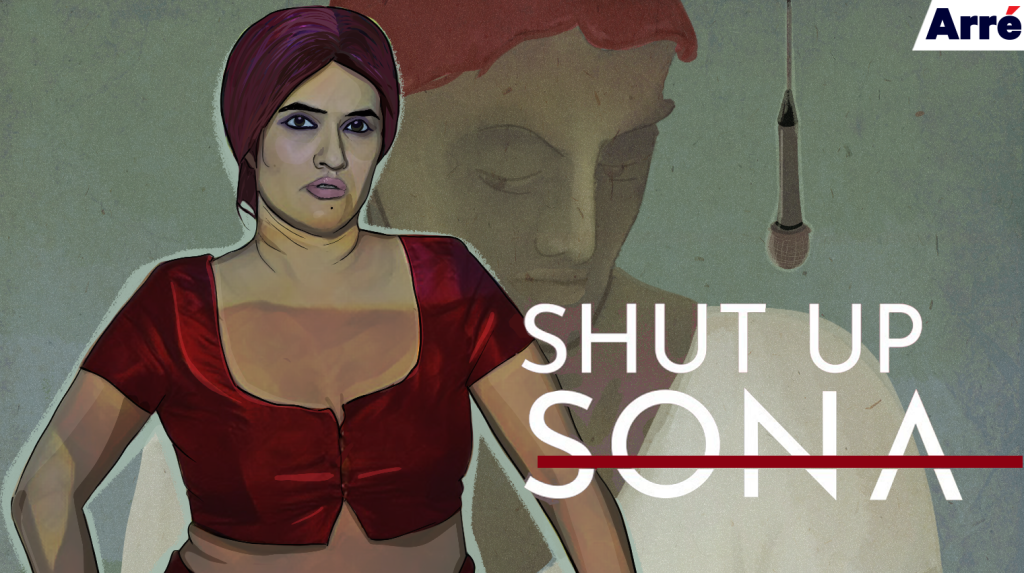
In India, where the odds are stacked so starkly against women, female performers don’t have the luxury of just being entertainers.Adamant about not letting IIT Bombay get away with sexism this time around, Mohapatra decides to write an open letter. Sampath advises her to not put it out. “Think about how you’re already perceived. They want you to fall into that cliche.. of activist mode,” he warns her. But the singer goes ahead and publishes the open letter anyway, blasting IIT Bombay for being a training ground for the worst kind of boys club (“All the mathematical equations in the world will not be able to teach you the equation of fairness” goes one line of her letter). On their part, IIT Bombay deny her claim, implying in a way that it might just be all in her head. In a way, this forms the crux of the message that Gupta tries to capture in Shut Up Sona. That, in India, where the odds are stacked so starkly against women, female performers don’t have the luxury of just being entertainers. It’s impossible to be someone who refuses to dilute her voice, compromise on her freedom of expression, or consent to be taken for granted, without a degree of activism. The documentary argues that Sona Mohapatra is all of these things: She stands up against sexism and refuses to be second-guessed about her worth. But its significance lies in how it acts as a witness to the never-ending punishment that the singer has to endure for not being submissive; for being demanding instead of accepting; for using her voice instead of hushing it. In the three-year-period that Shut Up Sona follows Mohapatra, there’s an FIR and innumerable rape threats against her, a case of colleges not inviting her to perform at fests, and prime-time TV debates that hyperfixate on the “lack of modesty” in her wardrobe. All Mohapatra wants is to not feel ashamed for wanting to be treated as an equal but no one is bothered to take her seriously, even. Shut Up Sona charts out this dichotomy convincingly. Mohapatra isn’t the kind of woman who is easily intimidated (she took on Salman Khan for his “raped woman” comment). But even then, her career ultimately rests at the mercy of men and how they choose to perceive her, which for a large part, is based on how she dresses. For instance, the Sufi Foundation lodges an FIR against her, accusing her of “trying to insult Islamic Sufi practices by wearing objectionable, body revealing, obscene apparel” in a music video. A portion of this video is played in the next scene to drive home the glaring inaccuracy of that claim. This lends itself as a captivating thread of the narrative as well: Through Mohapatra, Gupta posits how one of the more insidious ways of curbing a woman’s freedom of expression is to attack how much skin she chooses to bare. In that sense, Mohapatra is both an easy target and a threat, given how unaffected she is by letting society dictate how much cleavage she should reveal or how flamboyantly she might dress onstage.
Shut Up Sona works even better as a record of a female artiste, whose very existence is rebellion against the habitual erasure of women’s contributions.Naturally, it’s a lot of ground to cover and Gupta skims through most of the details – a decision that partly hurts the narrative. For instance, #MeToo is alluded to in a couple of lines in the closing slate and Gupta strays away from delving on the consequences that accusing Kailash Kher and Anu Malik of harassment might have had on the singer’s career. Its effect is further weakened by Gupta’s insistence to unnecessarily crowd Shut Up Sona with evidence of historical oppression of women to explain present-day power imbalances. It’s an ambitious detour, but which can come across as confusing, relying far too much on easy equivalences. Still, Shut Up Sona is at its strongest when it concerns itself with being a character study that argues that Mohapatra’s bravery is also self-sabotage. It benefits from the filmmaker’s perceptive eye for detail, as she tenderly ekes out the varying, at times contrasting shades to Mohapatra’s personality. Gupta paints Mohapatra as an invested performer (montages of the singer on stage are a thing of joy; she almost lights up the stage with her presence) and a generous celebrity (her interactions with women bring out the talkative side in her), one who is perennially cracking jokes or flashing a smile (She openly scoffs at Sampath when he claims that a man and a woman are equal according to Hinduism). Yet, this isn’t the side of her that the world chooses to see – for them, she is always the angry woman, one who is shouting all the time. Mohapatra, the performer, is gamed to always come second. At a time when pop-culture readily bends itself to accommodate innumerable makings of the male genius, hyping it up as invaluable “behind-the-scenes” extension of art itself, Shut Up Sona feels like a counter. It works even better as an acknowledgement of a female artiste; as a cinematic record of the sheer “pluck” it takes to co-exist in a world that is biased towards male geniuses. The very existence of Shut Up Sona then, is rebellion against the habitual erasure of women’s contributions to industries made by men for men (It’s not a coincidence that Mohapatra is also credited as the producer). There’s a scene in the documentary where the singer animatedly recounts the time Vishal Dadlani patronised her when she pointed out the lack of female performers at NH7 Weekender. “Who are the women artists after all?,” he had asked Mohapatra. Shut Up Sona is a seething answer to that question. Shut Up Sona is playing at the 2019 edition of MAMI Film Festival.