
C
inema allows for the imagination to run wild, to travel far with its flights of fancy and take you to places you’ve never even conceived of before. But the depiction of gangsters specifically has been limited by only an experimentation in the kind of violence they inflict upon one another, or the dialogues they exchange.
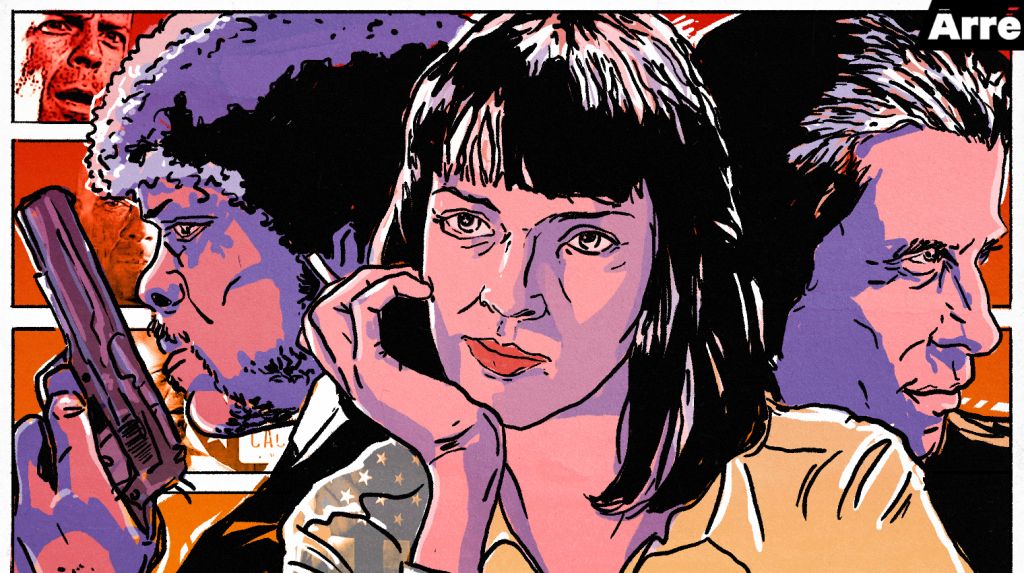
Safe to say, I had never seen a movie gangster take a shit before watching it gloriously unfold in Quentin Tarantino’s bonafide masterpiece Pulp Fiction. So to see John Travolta in an ugly T-shirt, reading a magazine in a snug toilet room a few moments after inadvertently blowing someone’s brains out onto the back of a car, and right before he himself is shot to death, was funny, sure, but strangely enough, also revolutionary.
This symbol of cinema cool, the urban gangster on the streets of New York/Brooklyn/LA/Miami, mostly seen with a cigarette between his lips and a general look of calm on his face, was pictured in Pulp Fiction taking casual dumps and discussing the pros and cons of foot massages. The film cushioned its scenes of extreme and gruesome violence, typical of gangster films, with long drawn-out scenes of people just being people, atypical of any film at all. Not gangsters, boxers, kingpins, drug-addicts – just people.
Pulp Fiction is at its essence a story about not very much except its characters. And Tarantino has since built an entire career out of etching out characters more than plot. A Band Apart/ Jersey Films
Tarantino builds his cinematic universe through dialogue, through the manner in which people speak to each other and about other things. Alfred Hitchcock said that cinema is life without the boring bits, but Tarantino loves the boring bits. He sharpens the boring bits, carves it to exactly what he wants and delivers dialogues like “That’s a pretty fucking good milkshake. I don’t know if it’s worth five dollars but it’s pretty fucking good.” Does it take the plot ahead? No. Does it tell us about who Vincent Vega (John Travolta) is? Absolutely. My other favourite: “Aw man, I shot Marvin in the face” after Vega shoots a man right in the face. It tells us about the nature of what a Tarantino universe looks like – violence is casual, and that’s why it’s funny. The bad guys are the protagonists, but despite them donning their traditionally cool avatars, we spend 2.5 hours laughing at them bumbling through life and existence, even if they happen to be quite efficient at their jobs. The Vega-Jules conversation at the start of the film sets up the universe perfectly – an undramatic conversation written so dramatically that serves to soften the eventual violence that takes place later. And when you watch it a second time, the knowledge of what is to happen later makes the initial sequence even funnier. Interestingly, there are no cops in this entire movie. Somewhere in the backdrop of all this violence is a procedural drama, a detective stringing together nonlinear clues and figuring out how to catch the bad guys. But the chase is irrelevant in the Tarantino-verse. He’s more interested in how gangsters discuss taking blood stains off expensive towels (discuss, not see them actually do it). If we were to get the chase movie this could have been, we’d be hearing about buddy cops arguing over the best donuts in Los Angeles. Pulp Fiction has historically been one of those movies that everyone seems to constantly pay tributes to, but nobody really knows why. Tarantino is a bit like religion – you really have to like him if you want to get into cinema, and the more you question it, the more brickbats you get. This unfortunately takes away from the fact that the man is an actual genius even when you sit down to think about it, and Pulp Fiction is our generation’s Breathless, yet far more accessible, and straight up fun. His insistence on creating a bereft of morality universe opens a window to an imagination none of us have encountered. There are new ways of looking at the film each time one watches it – it’s almost as if the more knowledge you accumulate about the film, the more enjoyable it gets. It’s zany, ridiculous, funny, and downright astounding, and nobody has made a film like it since. Not even Tarantino.Tarantino builds his cinematic universe through dialogue, through the manner in which people speak to each other and about other things.