
W
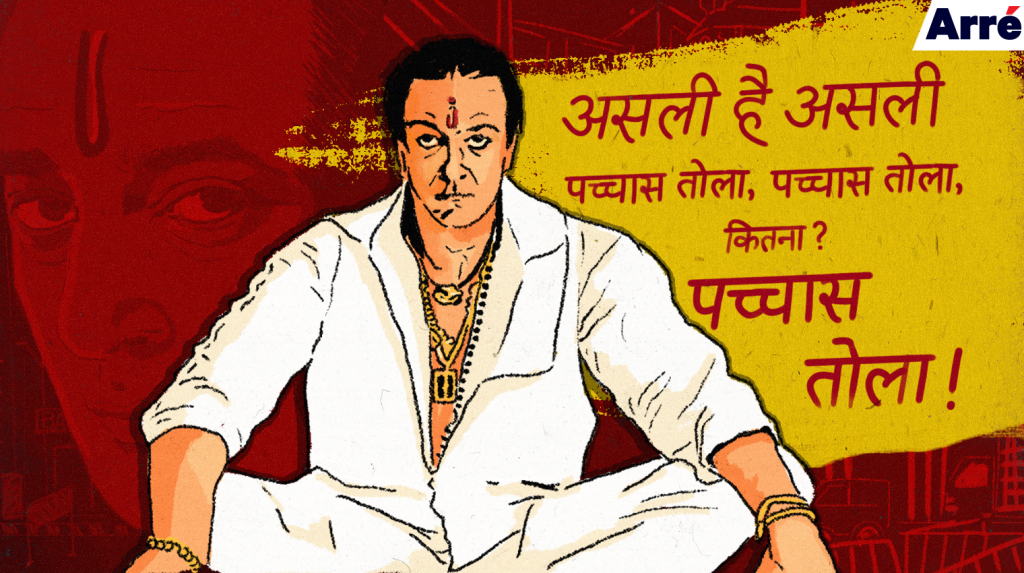
hat does Bombay sound like? Below the treble of traffic jams and the thumping bass of a jayanti or an utsav, the soundtrack of this city comes from a motley crew of ordinary men, who produce the curious medley of inflection we call “Bambaiya Hindi”. This bastard love child of demure Urdu, virginal Hindi, and boisterous yet passionate Marathi that the residents of the city use to communicate, was mainstreamed by the underworld, and more specifically movies like Mahesh Manjrekar’s Vaastav. Loosely based on the life of Mumbai don Chhota Rajan, the film, written by Imtiyaz Hussain (who also wrote Ghulam-E-Mustafa, another cult gangster saga) helped parlance such as “ghoda” and “50 tola” seamlessly seep into our Hindi. And the average Mumbaikar somehow took to it like moths to a halogen light in a Navratri pandal.
I would know. I’ve lived in Bombay all my life. I was nine when Vaastav released. Back then, theaters in my neck of south central Bombay – Byculla, Parel, Lalbaugh – reeked of body odour and stale wafers. There was no way to discount bed bug infestations, and the danger of encountering a stranger with his hand in his pants, eyes glued to the lovesick couple in the corner seats instead of the screen, loomed large. This meant that going to the movies was an entirely avoidable exercise. So I developed a shortcut: I’d watch the pirated prints of the latest releases, like the uncut version of American Beauty, on VHS borrowed from my local library.
Vaastav’s dialogues are a gift that keeps giving. My friends and I would try and slip a “pachaas tola” here and a “khalaas” there no matter what we were talking about, girls or goons. Adishakti Films/ Eros Entertainment 
Vaastav set a template that went beyond the usual apun-tapun; it showed us that, though not lyrical, the tapori language oozed bonhomie and brotherhood. Years later, Munnabhai MBBS and most recently, Gully Boy did what Vaastav set the trend for – give Bollywood dialogues a coloquial veneer that’s generally missing. Today, punter log have become bantais and street slang has made its way to Twitter, but there is nothing that matches Sanju Baba’s guttural “Pachaas tola”. These phrases coalesce to become tidal waves that are representative of Mumbai’s identity. They are a snapshot of what this city beyond the Queen’s Necklace and its plush skyscrapers is really like. Films like Vaastav are rich photo albums that, just like Mumbai, are a crude amalgamation of different cultures, ideologies and classes, held together by a couple of “aailas” and a bit of “bhenchod”. I imagine, it’s a fusion hard to fathom for chaste tongued newcomers, but for Mumbaikars, it’s an unwritten code, a secret language that bridges all divides and brings us together. It is the sound of home.Vaastav set a template that went beyond the usual apun-tapun; it showed us that, though not lyrical, the tapori language oozed bonhomie and brotherhood.