
M
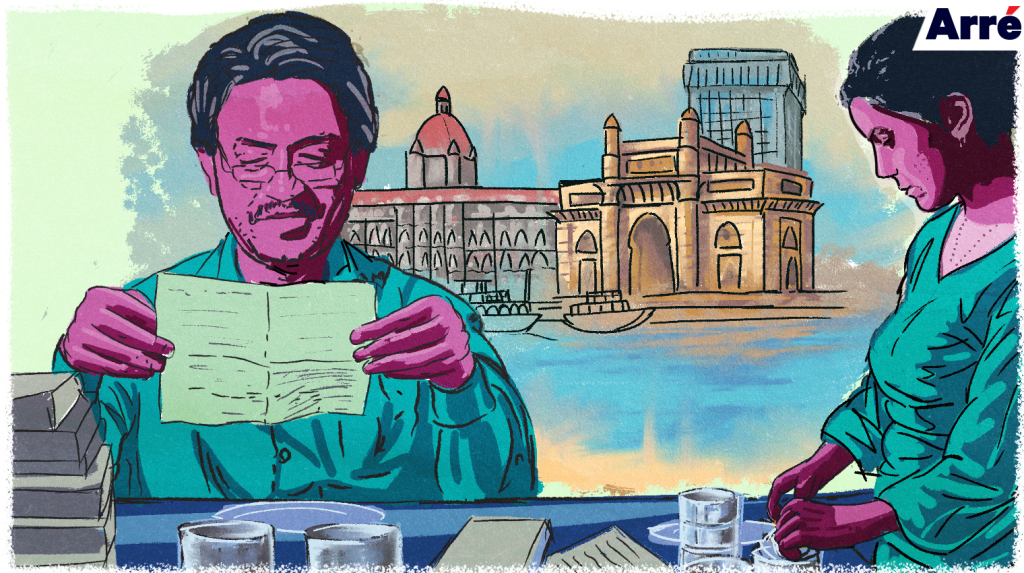
umbai is the city of the starved. Every second person in this brimming, alienating, gruelling city is invariably searching for sustenance – dietary, physical, but also emotional. It’s the kind of cyclical hunger that tends to deplete but also in its own way, drives a swarm of faceless men and women to survive day after day, at the cost of perishing. To live in Mumbai is to suffer. The city is a disease and its inhabitants, the diseased. There is no Hindi movie in recent times that has made this distinction with as much of an aching clarity as Ritesh Batra’s The Lunchbox. Released six years ago, Batra’s debut film, an epistolary romance, is a strikingly unadorned affair. At its heart is a tale that is as old as time: two disparate lives whose trajectories collide despite the social barriers the world has put in place to distance them. These lives are Ila (Nimrat Kaur), a young neglected wife, and Sajjan Fernandes (Irrfan Khan), a middle-aged widower. It’s fitting that The Lunchbox is set in Mumbai, given that its themes are centred on a host of contradictions: modernisation and stagnation, youth and old age, promotion and retirement, and a union of marriage and enforced solitude. What stands out however is how Batra strays away from following convention, evident in his reluctance to make the film’s narrative all about the tussle between the city’s inherent contradictions. Instead, The Lunchbox gently places these next to each other. Notice how the distance between Ila and her husband despite their physical proximity is juxtaposed with the emotional intimacy between Ila and Sajjan, inspite of them being gloriously unaware of the intricacies of each other’s existence. It’s as if Batra invites two distinct parts of life experiences – habituated to fight against one another – to confront each other in the living room, in a way making them whole, eventually revealing how dependent they are on each other. The Lunchbox then, thrives more on recreating the dichotomies of life instead of merely resembling them. It is a reminder that more often than not, crushing loneliness is the window to unabashed longing. You have to have lost everything to not be worried about losing anything.The Lunchbox recreates the dichotomies of life instead of merely resembling them. UTV Motion Pictures
The Lunchbox is then, a film that thrives on the various little ways – seen and unseen – we forge connections in a city that works overtime to alienate us.Still, every rewatch of The Lunchbox seems to do an even better job of satiating the emotional hunger that arises out of the loneliness that suddenly creeps up when you’re surrounded by people. One of the film’s most tender and heartbreaking scenes is at the cafe where Sajjan and Ila plan to finally meet each other for the first time. Ila is seated at a table, nervously sipping water, her eyes glued to the door of the cafe and Sajjan is seated right next to it. Ila isn’t aware of his presence, but Sajjan is of his existence and more crucially, his shortcomings. It takes someone calling him “Uncle” in the train earlier for him to realise that his world-weariness might just end up being too much of a burden for Ila. So he maintains his distance and yet he can’t take his eyes off her. Every gesture, look, and frown in the sequence gives meaning to longing: the feeling of not exactly knowing who you’re looking for, but knowing deep in your bones that you need to keep your search going. It’s a terrific metaphor for Mumbai. After all, the city like its inhabitants, is never satiated. Corrigendum: The earlier article erroneously mentioned that The Lunchbox released five years ago. It released in September 2013.