
I
s it possible to make an unbiased film about a real-life event? Is it possible not to take sides while recreating, or in Bollywood-speak, being “loosely inspired” by an incident that stirred passions and rocked the conscience of a country? The simple answer is no, at least not while existing within the framework of
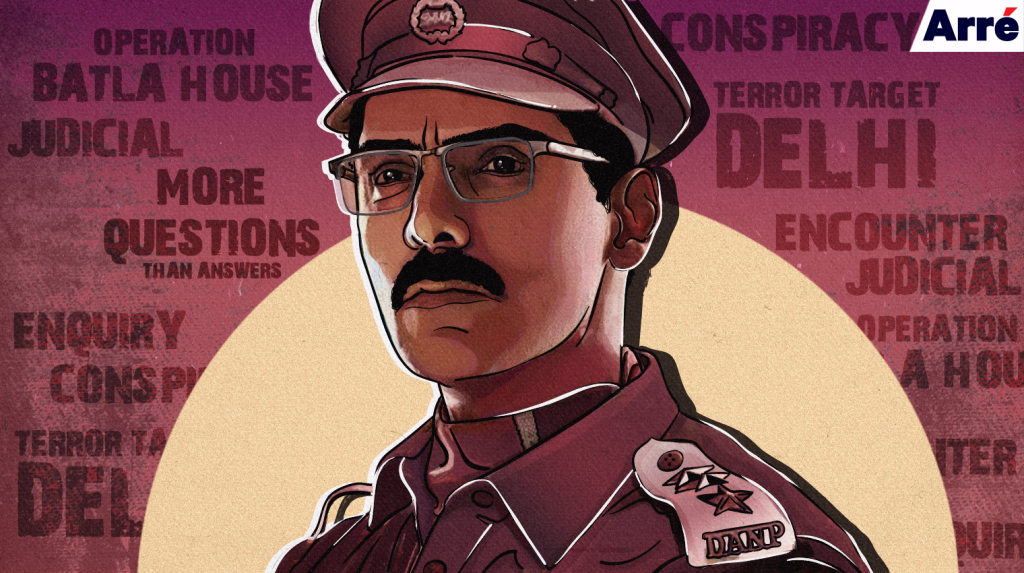
Bollywood’s unflinching devotion to duality. There’s always good warring with evil; darkness fighting light in Hindi films. The average Indian audience member expects a hero when they enter the theatre; they need someone to root for. Nikhil Advani’s Batla House gives the audience that hero, struggling at times, with the very idea of objective truth. Inspired by and told largely from the point of view of Delhi Police Special Cell DCP Sanjeev Kumar Yadav (John Abraham) – a record nine-time gallantry medal awardee – Batla House recreates the events that unfolded on the morning of September 19, 2008. For over a decade now, theories have been flying thick and fast about what exactly happened on that fateful day. The official version is that a covert operation by Delhi Police’s Special Cell to apprehend the linchpins of the terrorist organisation Indian Mujahideen turned into an encounter in which a decorated police officer and two terrorists were killed, two were arrested, and one managed to escape, after they unexpectedly opened fire on the police. The general consensus among human rights watchers, the media, and the general public was that the encounter was faked and the Muslim college-going boys were used as scapegoats by the Delhi Police to deflect attention from its inability to provide an enraged and volatile public with answers about the five serial bomb blasts that had shaken Delhi, killing 30 and injuring over a 100. Inquiries, investigations, and reviews followed. Although Delhi Police received a clean chit, and was even awarded medals for their bravery, the fake encounter narrative persists. The first half of Batla House follows DCP Yadav as his life is turned upside down following the widespread anger and disbelief, and the resulting protests. We watch him relieve the incident over and over – in his head and for all the people tasked with investigating his team – wracked with guilt over the death of his colleague, wondering if he really did go wrong. Abraham is surprisingly competent as DCP Sanjeev Kumar Yadav. For once, he wields his stoic demeanour to complement the mayhem unfolding on the screen, instead of distracting from it.
Inspired by and told largely from the point of view of Delhi Police Special Cell DCP Sanjeev Kumar Yadav (John Abraham) – a record nine-time gallantry medal awardee – Batla House recreates the events that unfolded on the morning of September 19, 2008.
Emmay Entertainment/T-series/John Abraham Entertainment
By the time Abraham’s ending monologue – surprisingly astute and well-written – rolls out, its impact is diluted by the heavy-handedness with which Advani directs the courtroom scene it follows. It’s not that Batla House is boring, but the sad part is that there was real potential to feel so much more. It could have made us introspect, and made us worry about what we’re allowed to see and what we aren’t. But why bother with nuance when deshbhakti is so much easier to sell?It’s not that Batla House is boring, but the sad part is that there was real potential to feel so much more.