
I
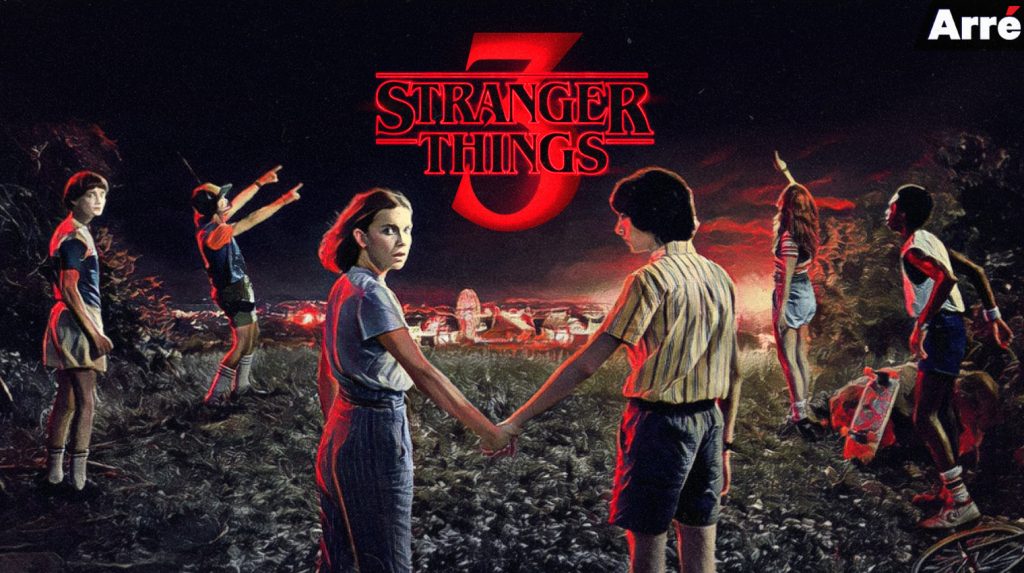
t’s that time of the year when we willingly get transported back to Hawkins again. The year is 1985 in Stranger Things and our favourite teenagers-in-making, Will, Lucas, and Mike, are playing Dungeons and Dragons while toothless genius Dustin is at Camp Know Where. Eleven has taken a break from her superpowers and spends her days kissing Mike for hours, much to her adopted father Hopper’s disgust. Most of the adults on the other hand spend their days by the poolside staring at a hot lifeguard while others like Hopper are working up enough courage to ask Joyce, an old friend out to dinner. Before you know it, the door to the other dimension is opened yet again, leading to the return of the otherworldly monster. This time, it is the Mind Flayer. On first glance, the third season doesn’t deviate much from the origins of its previous two seasons. As this Forbes review aptly summarises, “The Upside Down is opened, and closed, again. The Mind Flayer returns, takes some time to build a small army of civilians, and is promptly defeated. Instead of sinister American scientists, there is sinister Soviet scientists. Other than the shape of the monster, little has changed.” At this point, the very elements – smart kids with a scientific bent of mind, a mysterious girl with psychokinetic and telepathic abilities, a monster who is difficult to defeat, adults who carry immense emotional baggage and some fabulous spine-chilling climaxes – that made Stranger Things a phenomenon, are the things that are making it go from good to predictable every year. Even in this installment of Stranger Things, the kids get to know of the monster before anyone else does and Eleven more or less saves the day. That’s it, end of season. Truth is, it ain’t getting any stranger than this. Much of the growing genericness of Stranger Things can perhaps be attributed to its unprecedented popularity back in 2016. A problem that arises out of being heralded as a successful series is that people want more of it, stretching the rubber band too far at times. At a time when Big Bang Theory ends after 12 excruciating seasons and The Handmaid’s Tale squanders its ingenious premise with yet another meandering season, is it any surprise that Stranger Things is teasing a fourth season? The marker of a successful show, is afterall, still considered extension. Except in the current pop-culture consuming culture, an extension is also fraught with terms and conditions about how engaging the show would remain to be. Usually, it never lives up. In its current season for instance, Stranger Things, it can be argued, feels less like a season, and more like a marketing exercise. Would it really have been such a bad idea if the show had ended a season ago instead of harming its own appeal by stretching itself thin?Despite the rewarding takeaways of Stranger Things, including that heart-rending finale, it’s become almost impossible to not wonder whether the third season is mere fan-service rather than just a natural progression of arguably, one of the most original shows to have come out of the Netflix stable. The current season’s flawed logic and derivative storyline suggests that its success entirely relies on the show’s ability to mine pop-culture nostalgia as its calling card. Stranger Things then, exhibits the grand old sequel problem: It is a watchable follow-up of an inventive show that has very little to do other than just showing up on our screens every year. As journalist Kathryan VanArendonk claims, somewhere along the line, longer TV has become equated with being worthier TV: She points out how it started on cable, “where a prestige drama on HBO meant a full hour-long runtime rather than the measly 43 minutes granted to an episode on commercial television.” Yet in an era of streaming television, long shows are a perennial misfit. An Atlantic essay titled, “The TV is Too Long” puts the side-effects of “longer TV” in perspective, “The paradox of living in this specific cultural moment is that people have less free time than ever and infinitely more things to watch – and yet the powers that be have been compelled to stretch many of those shows into packages that rival, in their running time, the audiobook of Moby Dick. Single installments in dramatic series run 70, 80, even 90 minutes long. Mid-season streaming episodes in which not a single dynamic thing happens reliably last an entire hour.”The current season’s flawed logic and derivative storyline suggests that its success entirely relies on the show’s ability to mine pop-culture nostalgia.
In its current season for instance, Stranger Things, it can be argued, feels less like a season, and more like a marketing exercise. Netflix