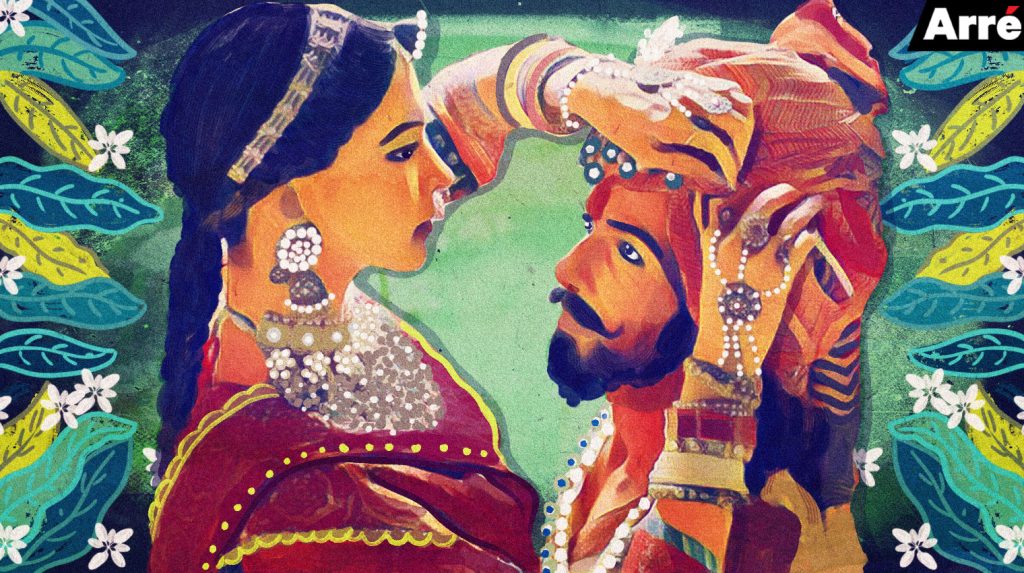

Bollywood’s penchant for period and costume dramas has conjured up countless queens and princesses, stretching back to its very first film,
Raja Harishchandra, in 1913 – a time in film history when men played women. Here, Harishchandra’s wife, Queen Taramati, suffers hardships and is wrongly accused of a crime. Its cinematic distinction aside, the film’s leading lady would become the template for representing royalty: From Rani Rupmati (1957) to Padmavati, each queen who came after Taramati is just as pious and uncomplaining. A plethora of historical and mythological dramas in the ’30s and ’40s enabled this archetype, dolling up royal heroines in fine regalia, and making them wax lyrical about “honour” and “duty”. So when SS Rajamouli’s South Indian fantasy epic Baahubali 2: The Conclusion (2017) hit theatres decades later, Bollywood went into a bit of a tizzy over the fierce feminism of Princess Devasena and Queen Sivagami. Indian cinema had finally found two truly empowered mainstream royal heroines who didn’t merely exist for the men. Devasena isn’t just another action hero with exceptional combat skills, she’s also compassionate, self-aware, and in control. And as regent, Sivagami is a strategic thinker who governs the kingdom of Mahishmati with unflinching fairness. Amidst the testosterone, blood, brawn, and bull fights, these steely women shine the brightest.
UTV Motion Pictures
The weapon-wielding woman trope is often thrust into the plot, a feeble token to prove that the heroine isn’t just a pretty face.Naturally, these villainous queens are not spared from serving as a romantic trope in male-driven stories, where the hardened hero brings the bratty heroine into submission. Be it Aan (1952), Dharam Veer or Azaad (1978), every petulant princess worth her riyaasat has been humbled by the hero in the most masochistic manner. Somehow, she always falls for the hero after being abducted, bossed around, and manhandled by him. Because a woman’s idea of getting wooed is exactly that. Even contemporary Bollywood that should know better has done precious little to break these clichés. The weapon-wielding woman trope is often thrust into the plot, a feeble token to prove that the heroine isn’t just a pretty face. Would it be more effective to just write strong women characters? Well, yes, but tell that to last year’s Thugs of Hindostan (2018), where Princess Zafira (Fatima Sana Sheikh) is a swashbuckling warrior who, for some reason, keeps getting rescued by the men. Or to Rani Padmavati in the epic Padmaavat (2018), who, despite being the badass princess of Sinhala, becomes a sacrificial pawn in a game between kings. Clearly, little has changed in the decade since Jodhaa Akbar gave us an empress who is a skilled swordfighter and Akbar’s equal in both wit and resolve, but whose biggest battle remains gaining a footing in the royal kitchen.

Viacom 18 Motion Pictures