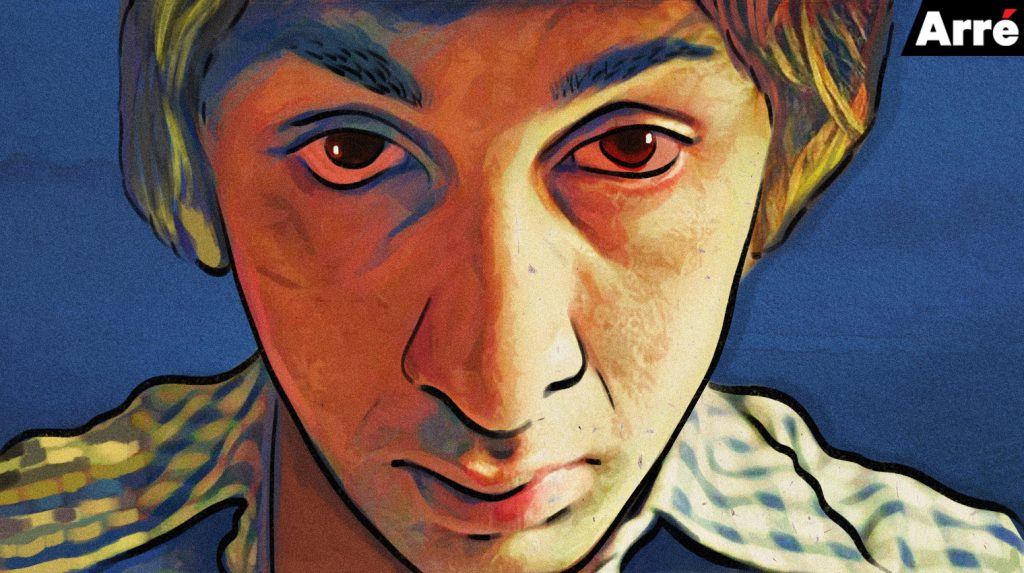

Yesterday, in a packed early morning show, I watched
Sanju with a sense of familiar anticipation. Of course, I was curious to see what Rajkumar Hirani would make of his source material – Sanjay Dutt’s fascinating and chequered life – but the reason I’d turned up was Ranbir Kapoor. Almost two years ago, when the first teaser of Karan Johar’s Ae Dil Hai Mushkil released, it started on a very un-Dharma note: a close-up of its lead mouthing lyrics and staring into the camera. Insipid – except when the lead is Ranbir Kapoor and his achingly expressive face. Kapoor looks at the camera and gives it one of his trademark vacant stares, his brown eyes brimming with hurt, his face in a mask of steely determination that refuses to allow any loss to overpower his love. When I watched the teaser for the first time, Kapoor’s ability to command a viewer’s attention with a mundane shot of him just lip-syncing to the film’s title track impressed me. But months later when I watched the film, I came out affected by his magnetism. The exact effect that unfailingly accompanies every Ranbir Kapoor outing in recent times.Ranbir Kapoor doesn’t just play fictional characters, he recreates them down to the very last detailIt’s why even his repetitive lost-boy-who-needs-to-be-woken-up feels invigorating every time. Think about it, his manchild act in Wake Up Sid is starkly distinct from his Bunny in Yeh Jawaani Hai Deewani or even Janardhan from Rockstar. Because it always comes on the back of another trademark Kapoor trait: physical acting that rarely hits a false note. Kapoor doesn’t just act or deliver lines. He disseminates the psyche of his characters with every part of his body. Every Kapoor twitch, raised eyebrow, hand movement, or the extent of a smile isn’t incidental. It is intended. The title track of Ae Dil Hai Mushkil lasts a mere three minutes, but you witness every imaginable response to love: gratitude, anger, obsessiveness, affection, crushing loss. For me, the lasting image of the song is a beautiful improvisation where Kapoor acts out the line, “Tu mera khuda, tu hi duaa mein shaamil”. The actor looks up at the sky, his eyes dart across as if he’s directly addressing his invisible muse, moulds his face into a half-smile, and tops it off with a slight raise of the eyebrow. It perfectly captures the feeling the whole film falters to evoke. It’s this captivating ability to infuse every burst of tantrum (Tamasha), restlessness (Wake Up Sid), an act as unremarkable as tucking in a turban (Rocket Singh: Salesman of the Year), convenient escapism (YJHD), easy tears and feminine gait (Channa Mereya in ADHM), and boyish wonder (Barfi!andJagga Jasoos) with an avalanche of emotions that makes the actor stand out. It’s also why even his staunchest fans don’t have favourite Ranbir Kapoor dialogues – they have favourite Kapoor moments. He gifts his audience the luxury of decoding the emotions playing out on his face. But, most importantly, he laces these emotions with enough history. Kapoor doesn’t just play fictional characters, he recreates them down to the very last detail. In a sea of Ranveers and Sushants and Siddharths and Varuns, Ranbir is Ranbir. Even if he hasn’t had a proper hit in years. We rarely realise that the actor does films that are harder than they look. Sanju for instance, to which Kapoor has given almost two years of his life. Irrespective of where you stand on the film’s whitewashing tactics, Kapoor elevates the biopic to arresting cinema.

Ranbir Kapoor is a scene-stealer in Rajkumar Hirani’s Sanju.
Image Credit: Vidhu Vinod Chopra Films