
T
he one-line message of Rajkumar Hirani’s Sanju (for which he also gets a story, screenplay, and editor credit) is encapsulated in a song employed in the film: “Kuch toh log kahenge, logon ka kaam hai kehna.” The idea is to invoke sentimentality, and it sets the tone of the entire film – an authorised biopic based on the life of Sanjay Dutt, arguably the movie event of the year – that’s brought to life by its compelling lead Ranbir Kapoor. It’s also its sole villain and most alarming of all, the stand Hirani decides to take in Sanju. But first, let’s get the essentials out of the way. Kapoor’s mercurial turn doesn’t just recreate the arresting persona of Dutt, but also gives a peek into his emotional core. He single-handedly makes Sanju affecting cinema, riding on the back of the electric chemistry he shares with Vicky Kaushal. But as a crowd-pleasing biopic, the verdict is clear: Sanjay Dutt shouldn’t be blamed. In Sanju, the treatment of every scene imbibes this stand. When the film isn’t engrossed in declaring, in no uncertain terms, that Dutt was a victim of his circumstances which were inaccurately exaggerated and sensationalised by the media, it moulds itself into a comedy. Take the now infamous scene where Winnie, a biographer (Anushka Sharma in a wasted role and wig) meets Dutt and tests the veracity of his story by asking him the total number of women he’s slept with. Dutt answers that once when he was drunk, he had roughly chalked up the number to around 350 women, minus sex workers. His admission is accompanied by a comical background score – as if womanising is a harmless punchline – and the occupants of the housefull theatre around me fittingly responded with collective laughter. The film brushing off of Dutt’s philanderous ways isn’t an exception – it’s the route adopted to communicate the emotional and moral transgressions of its lead. When he betrays his best friend (a scene-stealing Kaushal) by sleeping with his girlfriend, it’s because he was looking out for him by “testing her loyalty” as if sex isn’t a two-way street. He then goes on to question “her character”, and reduces the moment to a hilarious sequence, ably supported by a comical score.
This isn’t to argue that superstars shouldn’t be flawed or that those flaws shouldn’t make it to the screen. What is troublesome is the treatment of those flaws. Because, as we will later see, these supposedly harmless dismissals will be used to absolve Dutt of any wrongdoing. In a later scene, Dutt meets with a politician to clear his “terrorist” tag. The scene swiftly shifts focus to derive comedy from the sight of the ageing politician falling asleep mid-conversation. It’s as if the film itself doesn’t take the charges against Dutt seriously and presumes his innocence, shying away from exploring any level of his culpability. To deal with the judicial accusations against Dutt, Sanju comes up with predictable villains: The “terrorist” tag is the figment of every Indian tabloid’s over-enthusiastic imagination. He was never friendly with the underworld (Abu Salem dropping off an assault rifle to your house is an everyday occurrence, according to Sanju); just “forced” to acquaint himself with them to safeguard his life. He was in possession of an AK-56 only because he was scared of the rape and death threats of his family in the aftermath of the Babri Masjid riots. Naturally, he also disposed it, out of that same fear. Not only does Sanju imply that Dutt is in no way connected to the 1993 Mumbai blasts, but it even goes as far as labelling samachar as the “drug” that has overpowered the intellect of everyone who believes that he is a criminal. Basically, everyone (especially external factors) is at fault, but Dutt. To Hirani’s credit, Sanju does not shy away from emphasising Dutt’s drug abuse (Although, the film neatly caps it off by implying that Jim Sarbh’s Zubin Mistry is responsible for his addiction.) Or his jail stint, even though court proceedings are skimmed over and his imprisonment is only used as a device to goad empathy for his family. But in making the media’s unverified headlines the film’s greatest villain instead of Dutt’s self-destructive behaviour, Sanju does precisely what it proudly announces it doesn’t: glorify Sanjay Dutt. It’s a bit unfortunate that a clever, talented filmmaker like Hirani, who has his finger firmly on the pulse of India’s cinema-going audiences, would depict Dutt as a “flawed” and “broken” personality. There’s no denying that he is quite possibly all of those things, but there’s only so much that these traits can justify for the untoward actions of a grown man. “Bad choices make good stories”, sure; that would work had he not cemented Dutt as a misunderstood hero.Rajkumar Hirani’s insistence to not acknowledge that flawed men can own up to their flaws, is Sanju’s greatest weakness.

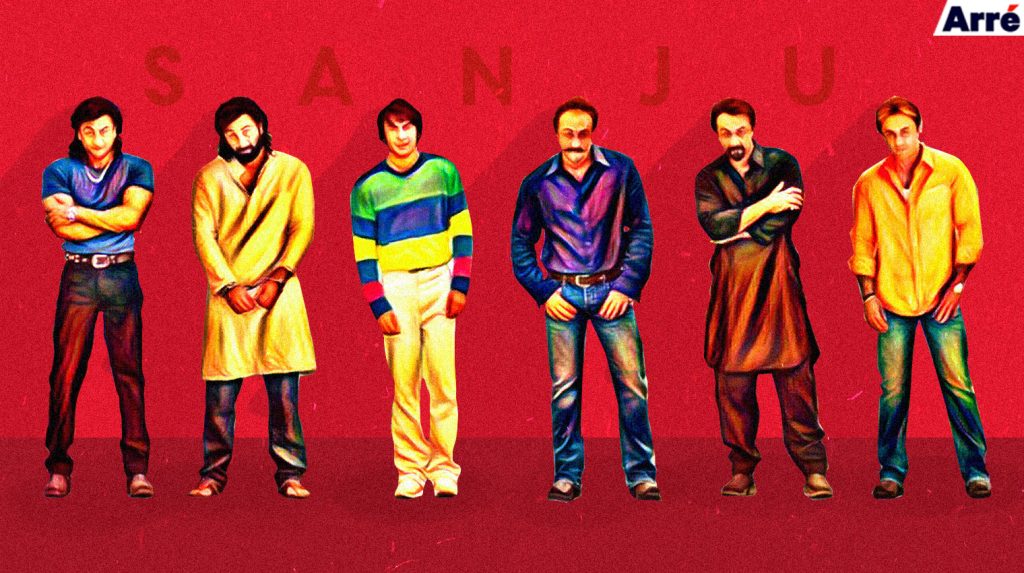
Ranbir Kapoor’s mercurial turn doesn’t just recreate the arresting persona of Sanjay Dutt, but also gives a peek into his emotional core. He single-handedly makes Sanju arresting cinema
Image credit: Vidhu Vinod Chopra Productions