
A
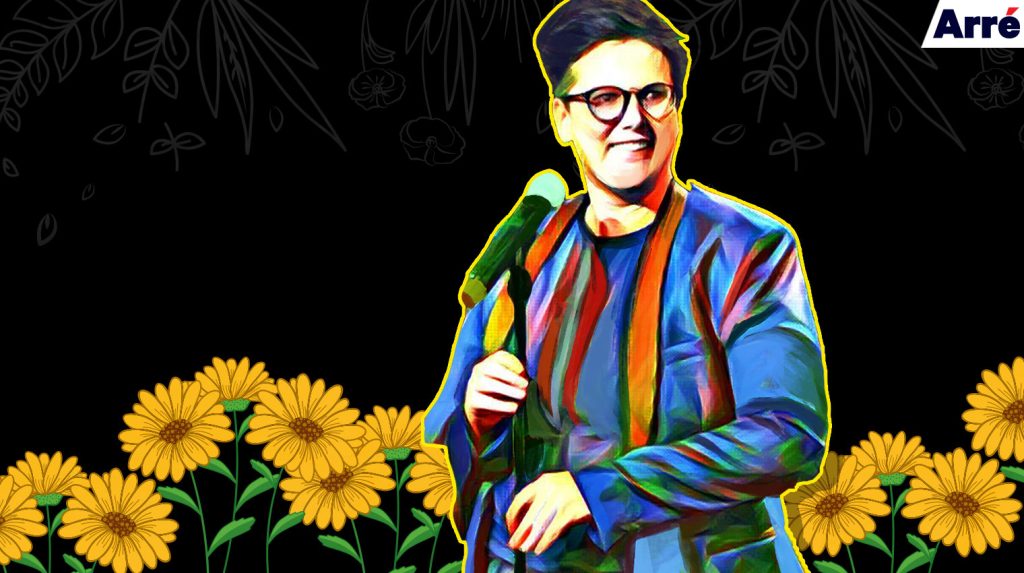
t one point in Nanette, a Netflix “comedy” special, Hannah Gadsby makes a plucky proclamation: “I have a responsibility to make you laugh. But I’m not in the mood.” Like me, the audience in her special laughed uncomfortably in unison – craving another punchline, hoping her announcement was a part of a gag. Except, the 40-year-old Australian comic stuck to her word, unrelenting in her disinterest to defuse the building tension in the room. Gadsby managed something very few comedians have: She reclaimed her authority over laughter. Not everyday does a comedian refuse to be held hostage to the audience’s validation; a comedian who changes the narrative by mounting a ferocious attack on comedy itself. In her hour-long special that is both comedy and anti-comedy, Gadsby deftly deconstructs the hypocrisy of a joke. “A joke is a question, artificially inseminated with tension. I make you all tense and then I cure it with a laugh,” she confesses. She delves into how, for a joke to elicit laughter, it has to be stripped of all its context. As a result, an audience only gets to hear the beginning and the comic middle of the story that is designed as a punchline. The structure of comedy forces jokes to only be a two-act medium. Every comedian, yearning for continuous, urgent laughter from the audience, unblinkingly sacrifices the third act of their story at the altar of their material. Like Gadsby, they mine their lives and their pain to present an abrupt, dishonest anecdote that is packaged as a joke. “This is an abusive relationship,” she declares, forcing her burgeoning audience to acknowledge the question she is hellbent on posing: What is the damn point of manipulative comedy? For effect, Gadsby illustrates the joke that she cracks about her mother’s reaction to her coming-out moment where she equates lesbians with murderers. It always guarantees laughter, the comedian insists. But to her, that’s no longer a priority. What bothers Gadsby much more is the fact that the joke allows no room for her mother’s apology, which actually caps off her coming out. In her story, her mother’s retort is barely another line. But, in her joke, it’s reduced to the punchline.
It’s what made her swear off self-deprecating humour. For most comedians, mocking their vulnerabilities for a joke usually comes without any consequences. For someone living in the margins like Gadsby, it’s debilitating her own identity for laughter. “It is not humility. It is humiliation,” she asserts. It’s also why she has decided to quit comedy. Gadsby’s angry breakdown of comedy and its prohibition of context also extends to her incisive takedown of society’s obsession with the same. It’s what prompts people to romanticise Vincent Van Gogh’s mental illness and instead focus on the sunflowers. It’s what’s promotes a culture of public worship of men like Roman Polanski, Bill Cosby, Pablo Picasso who create art that survives on the abuse of women – but are still afforded the luxury of separating their art from their abuse. It’s this lack of context that allows art history to be dominated by male artists “painting flesh vases for their dick flowers” and still be revered for it.Gadsby’s angry breakdown of comedy and its prohibition of context also extends to her incisive takedown of society’s obsession with the same.

At a time when a dime-a-dozen comedy specials are busy milking laughs from the eccentricities and accents of people who are different than us, Gadsby forces us to embrace that very difference.
Image Credits: ENews