
I
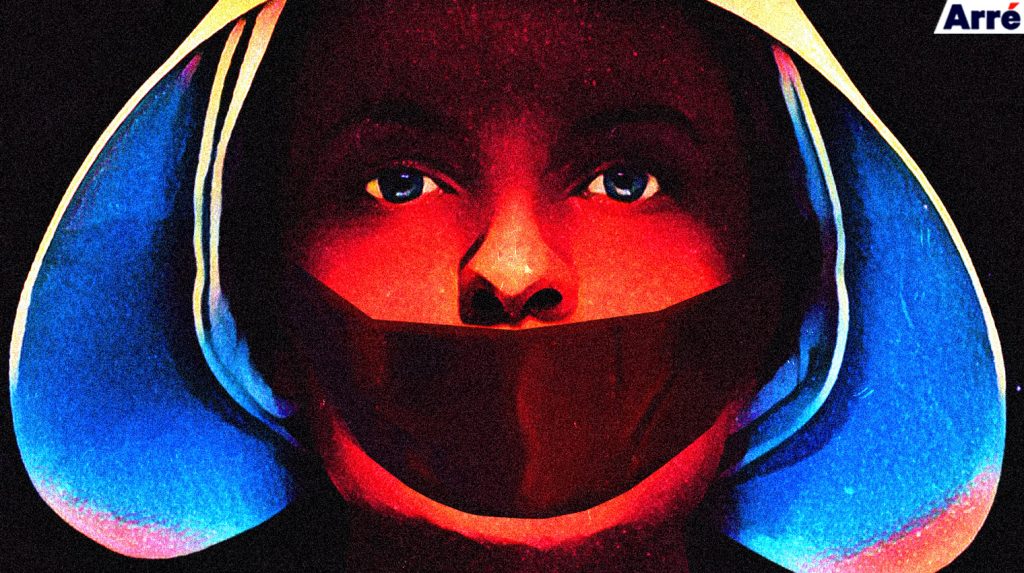
n the season two premiere episode of Hulu’s Emmy-winning The Handmaid’s Tale, titled “June”, the show’s creators convey an inescapable dispatch: It’s foolish to isolate the diabolical, gender-hierarchy-based politics of Gilead from our own world. In the first flashback of the spine-chilling episode, June Osborne (Elisabeth Moss) and her husband Luke Bankole are a portrait of domestic bliss. They live in an America that is not yet sullied by the draconian laws of Gilead, where women are classified by the purpose their bodies can serve for the men who control the country. June still has her job at the publishing house and a bank account. Luke’s biggest worry is having someone pick him some AA batteries, and their eight-year-old daughter Hannah, not yet separated from her parents, just wants more waffles. But there’s one disturbing detail to this normalcy, that foreshadows their bleak future. Before heading out for the day, June asks her husband to sign off on a form before she heads to the pharmacy. The request is matter-of-fact; the words aren’t explicitly spelled out, but it’s apparent from their behaviour that the elephant in the room is birth control. As we soon learn, a husband’s signature on a release waiver approving his wife’s decision to take birth-control pills is mandated by law. “They actually ask to see it?”, Luke asks exasperated, even as he exercises his power by signing the form. Remember the flashback is set in the 2010s, and not the 1950s. Instead of being upset about June’s “official” lack of agency in the matter of her own body, the couple indulge in a coy exchange culminating in an adorable moment where they decide that they should ditch the pills altogether and try for another baby. The sinister undertones to this moment are hard to ignore. Hypothetically, if Luke wanted a baby and June didn’t, he could very well withhold his signature, and have his way. It’s only his decision that counts; the law wouldn’t take her wishes into consideration for a second, for it has been introduced with the sole purpose of being in control of women’s bodies. It’s difficult not to see this as an extension of the the state of America right now, where anti-abortion legislations are at an all-time rise.
What’s even more frightening is the fact that both June and Luke appear to ignore the implications of this law – they’ve normalised a smaller, venomous iteration of Gilead to exist in their own home. It’s proof of the fact that the crimson cloaks and the damaging beliefs that make up Gilead didn’t magically come into existence overnight. Instead its traces have been around, and adhered to in the real world for a very, very long time. Except, we’ve ignored these silent warning calls. In a recent essay on how she came to write her award-winning novel, Margaret Atwood claimed that Gilead and its twisted dictatorship wasn’t just a figment of her imagination. “I made a rule for myself,” she writes. “I would not include anything that human beings had not already done in some other place or time, or for which the technology did not already exist. I did not wish to be accused of dark, twisted inventions, or of misrepresenting the human potential for deplorable behaviour. The group-activated hangings, the tearing apart of human beings, the clothing specific to castes and classes, the forced childbearing and the appropriation of the results, the children stolen by regimes and placed for upbringing with high-ranking officials, the forbidding of literacy, the denial of property rights – all had precedents, and many of these were to be found, not in other cultures and religions, but within Western society, and within the ‘Christian’ tradition itself.”I did not wish to be accused of dark, twisted inventions, or of misrepresenting the human potential for deplorable behaviour.

Come to think of it, Gilead isn’t all that different from India in how society forces young women to be child-bearers immediately after they are married off.
Image Credits: George Kraychyk/Hulu