
L
ast July, when Girls Trip released in theatres alongside Christopher Nolan’s widely anticipated Dunkirk and the sci-fi porn Valerian and the City of Thousand Planets, the all-women comedy was projected to gross only around $20 million. As luck would have it, the rib-ticklingly funny Tiffany Haddish, Jada Pinkett Smith, Queen Latifah, and Regina Hall-starrer was a box-office anomaly. It became 2017’s first live action comedy produced, written, and starring African-Americans to break the $100 million+ mark. The film had a unique marketing strategy: Girls Trip was sold as an event movie for adult women. The bawdy comedy’s success was a needful reminder of two facts. First, that it is imperative to treat any women-led film as an A-level event (no less than the Avengers frenzy that grapples the whole world). And second, not shy away from acknowledging that these films are targeted toward a starving demographic of women, who want to see versions of themselves on screen, having fun. Girls Trip then, managed an incredible feat: It quietly reclaimed the “chick-flick” genre; being lauded and loved by both men and women. Closer home, when the trailer of Shashanka Ghosh’s Veere Di Wedding — one of the most anticipated Bollywood films of the year — dropped last week, the air was rife with excitement. The big, bad testosterone-fuelled world of Bollywood that churns out factory-produced male-bonding cinema by the dozen, is hardly known to focus on light-hearted women-led films about the sanctity of female friendships. But if the trailer is any indication, Veere Di Wedding aims to fill this very gap.
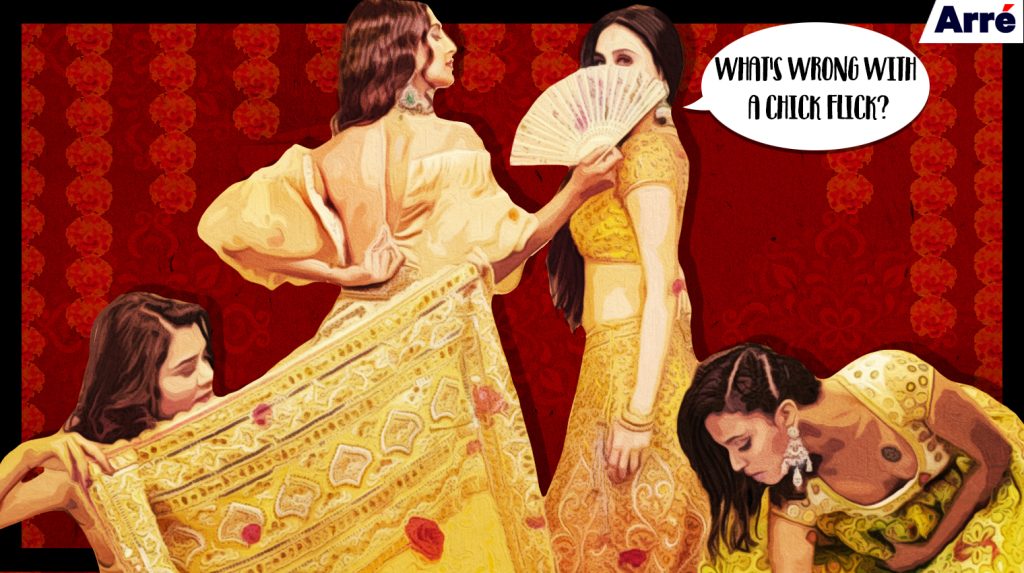
In the trailer, four besties — Kareena Kapoor (making her comeback after two years), Sonam Kapoor, Swara Bhaskar, and Shikha Talsania — drop truth bombs, cuss with pure abandon, discuss orgasms and sexism over drinks, and refuse to let marriage dictate their identities. Besides being a perfect antithesis to last year’s Lipstick Under My Burkha, the film looks and feels like a Bollywood iteration of Girls Trip that seems too good to be true. In fact, there’s even a scene in the trailer that directly evokes Girls Trip: a shot of the four friends laughing hand in hand as they set out for a night of partying. Except, Veere Di Wedding comes with a baffling condition: Its insistence at not being labelled a “chick flick”. The film’s promotions up until now have been riding on the back of one telling hashtag #ImNotAChickFlick. Because for a film to be taken seriously, it must eschew all the attendant baggage that comes with a film about women. In an op-ed column in the New York Times, feminist icon Gloria Steinem articulated what is my favourite definition of a chick flick. She wrote, “A chick flick is one that has more dialogue than car chases, more relationships than special effects, and whose suspense comes more from how people live, than from how they get killed.” To my mind, Veere Di Wedding, just like Bridesmaids and Girls Trip, seems to fulfil all of the above criteria. Further, the film boasts two female producers (Rhea Kapoor and Ekta Kapoor) and is co-written by a woman (Nidhi Mehra), which in the male-dominated bastion of the Hindi film industry, is an incredible feat. Why, then, are the filmmakers in such a hurry to disassociate from the very genre that they are contributing to? And, most importantly, what is wrong with being a chick flick?Films that depend on male-bonding or unabashed sexism seem to get away without being labelled.

Veere Di Wedding can be a great example of a Bollywood chick flick if it lets itself to be.
Image credit: Balaji Motion Pictures