
This line from
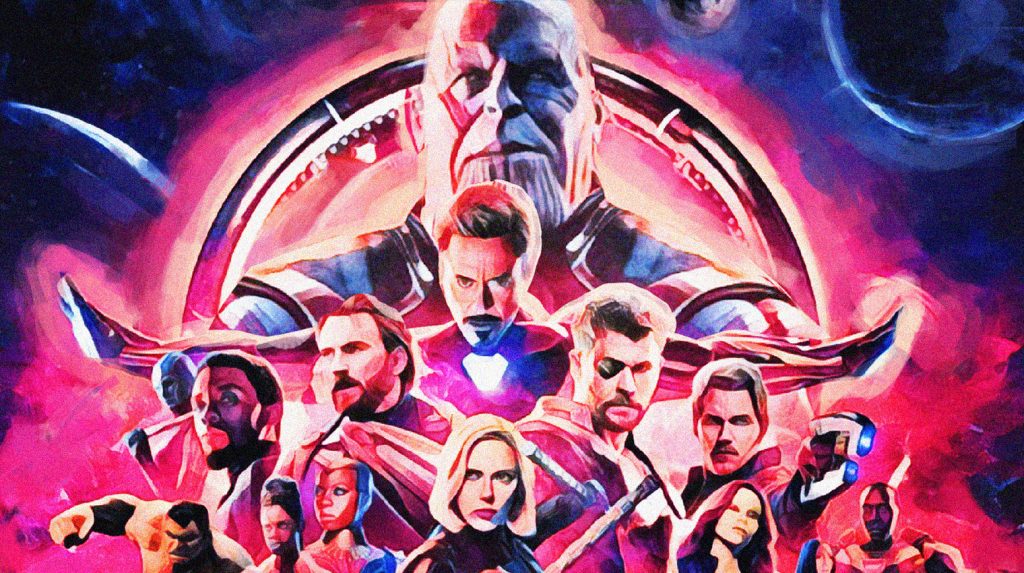
Avengers: Infinity War kept playing in my head on loop as I looked back at the rest of the shell-shocked audience, comprising film critics, established writers, journalists, and fanboys with a dictionary like me, who’d later face the challenge of articulating in words the emotional roller coaster that was Infinity War. We’ve been tasked with telling you what goes down and what to expect, without telling you what goes down and what to expect. As it turns out, spoilers are the latest villain the Marvel Cinematic Universe is adamant on fighting. Naturally then, the plot of Infinity War too demands to be kept as a closely guarded secret, on par with the recipe for Coca-Cola, Area 51, and the PM’s degree. In a way, the no-spoilers diktat given to the press falls in line with the MCU’s penchant for playing it safe. In the numerous films that preceded Infinity War in the last 10 years, our favourite superheroes were known to routinely rise up to the challenge of facing the most dangerous villains, threats, and uniting to stop their evil plan of world destruction from becoming a reality. It would make for a massive, visceral, and spell-binding display of what I like calling testosterone porn: flying objects and humans, mind-boggling weaponry, and dazzling action sequences. But, even with the reckless urgency of these various scenarios, Marvel’s reputation of shying away from taking risks guaranteed that fans have never quite felt the finality of grief. For these heroes, irrespective of how much danger they were in, would always emerge victorious. The franchise needed to continue, and so instalment after instalment, these heroes would be left incurably bruised only to appear cleansed in their next outing. Remember War Machine, when the uber cool Don Cheadle falls out of the sky in the first Avengers movie? Characters have died, only to be resurrected in the sequel. How do you suitably mourn the death of the lovable Groot in Guardians Of The Galaxy, when you are aware that its sequel makes up for the loss with the inclusion of Baby Groot?
Grief is everywhere in the film, and most surprisingly, it’s in the lump in your throat.
Image credit: Marvel Studios
It’s then fitting that anger-laced grief is the underlying thread tying the numerous characters and the multiple universes in this utterly dark but brave film.Why do we willingly submit to such torture? We long for battle, just so we can Instagram our scar; but also consider ourselves too woke to go to war. Which is why we willingly submit to big-budget BDSM vehicles like Infinity War, so that when the credits roll and the popcorn settles, we can huddle together, phones in hand seeking solace in our shared grief. Fittingly, the final act of Infinity War is essentially Kryptonite, or to keep the references strictly Marvel, the Terrigen mist (ask Google here), which either evolves or devolves anyone exposed to it. I’ll stick with evolves, because after this film you’ll look beyond the all-star cast and realise that the MCU is just a cleverly engineered fugazy designed to draw you in with the sole purpose of keeping its cinematic industrial complex running. And it’ll devolve you because by the end of the film, you’ll be reduced to a blithering blob in your plush reclining seat,with your broken heart, lying on the floor amid bits of popcorn and ticket stubs. You’ll repeatedly remind yourself that it’s all a figment of Stan Lee and Jim Starlin’s imagination, brought to life by an army of artists. But it still won’t stop you from hoping against hope that X didn’t just fade away into cinematic oblivion. Or finally coming around to accepting that not all superheroes are indomitable. But then again, denial is the first step in a break-up. A sad acceptance of the fact that Infinity War ek dhokha hai.