
I
n one of my earliest memories, I am a toddler bawling in the arms of an underage maid. She is standing on the top rung of a rickety wooden staircase, where a dark, narrow corridor leads to an open door. From inside the room, a bright white light emanates; two women are engaged in a tussle with an armed man. One of them is my mother. In that screaming chaos, the drunken man is flashing a knife, yelling, “randi, randi” at the top of his voice. The women scream back.
I extend one frantic arm in the direction of the door, trying to reach out to save my mother. It doesn’t help. Her finger gets chopped in the attack. There is blood.
This memory is so vivid that as an adult, I first believed it was a weirdly detailed dream, or a thrilling scene from a film that has remained stuck in my subconscious. But I’ve cross-checked: My mother’s cut finger has not grown back.
In the several retellings of this incident though, its ugliness has been dented. Humour nourishes my mother’s indomitable spirit and hearing her repeat it over the years, the attack has been rendered almost entertaining.
Each time we speak about it, she adds a new layer to the harrowing incident. One time she said she was proud of her stubby finger, that it makes her feel like the tragedienne Meena Kumari, whose pinkie had been deformed in an accident. Of course my mother feels that way. Meena Kumari had played the quintessential courtesan in Pakeezah, using her perfectly shaped other hand for graceful mudras.
Like Meena Kumari, every girl in the kotha conceals her flaws with artful coquetry, but how many of them can defeat the knives, swords, or penises that assault them?
***
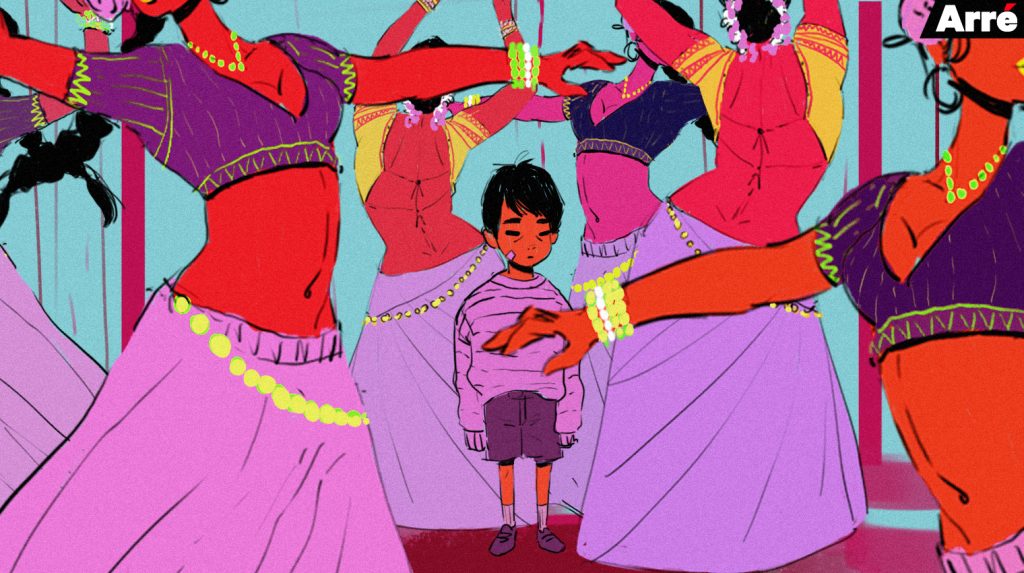
I grew up among the sounds of thumris, ghazals, the heady scents of mogra, and a splash of whiskey poured every night in these kothas located near Congress House. Image credit: Courtesans of Bombay/ Merchant Ivory Productions My mother’s name is Rekha. Line. A word we use to describe the interloping straits on our palms. Image credit: Manish Gaekwad

Where entertainers and admirers rubbed shoulders, could the avarice of the thugs be far? Goons claiming to be gangster Haji Mastan’s henchmen regularly showed up with weapons to intimidate the women. My mother was no easy target. When the bullies threatened to abduct me in exchange for one of her pretty sisters who looked after me, she fled back to Kolkata and literally deposited me in a boarding school in Kurseong, and later, Darjeeling, for my safety. Until then, the only privilege I’d had, as an illegitimate child from a married Muslim man she loved (and who decamped with her earnings), was being born. School was my second privilege. Had the criminals not come after us, my mother would not have panicked and hidden me away like precious jewellery in a remotely accessed vault. That vault was education. As a five-year-old, I returned to the kotha from the boarding school for my first winter vacation. During dinner, I studied my plate placed on the floor. “Mummy, where is my spoon and fork,” I asked. She wept. “Phat-phat angrezi bolta hai yeh toh,” she cried in disbelief, inviting the other women in the kotha to bear witness. I could speak a language that did not sound crude, vile, and debasing to her spirit. As it so happens in melodramatic films mirroring real life, my mother was too frail to bear a child when she got pregnant. The surgeon in the hospital who cut through her stomach to deliver me, had told her before wheeling her into the operation theatre, that he could save only one of us. The man she loved had forewarned her not to give me his surname if I made it alive. My mother’s horrified reaction to the surgeon’s one-option procedure was, “Kill the baby.” Mummy and I have giggled over this story a number of times, on how OTT it sounds, how tragicomic. And then there is also the practicality of her outburst. What would have become of me if she had died during the operation? It is only through our shared sorrows revisited with laughter that the trauma of our lives become bearable. My mother’s name is Rekha. Line. A word we use to describe the interloping straits on our palms. Palmists examine the lines to predict the future. She cannot read, or write, but she shaped my future, fully comprehending that hers was denied.In one of my earliest memories, I am a toddler bawling in the arms of an underage maid