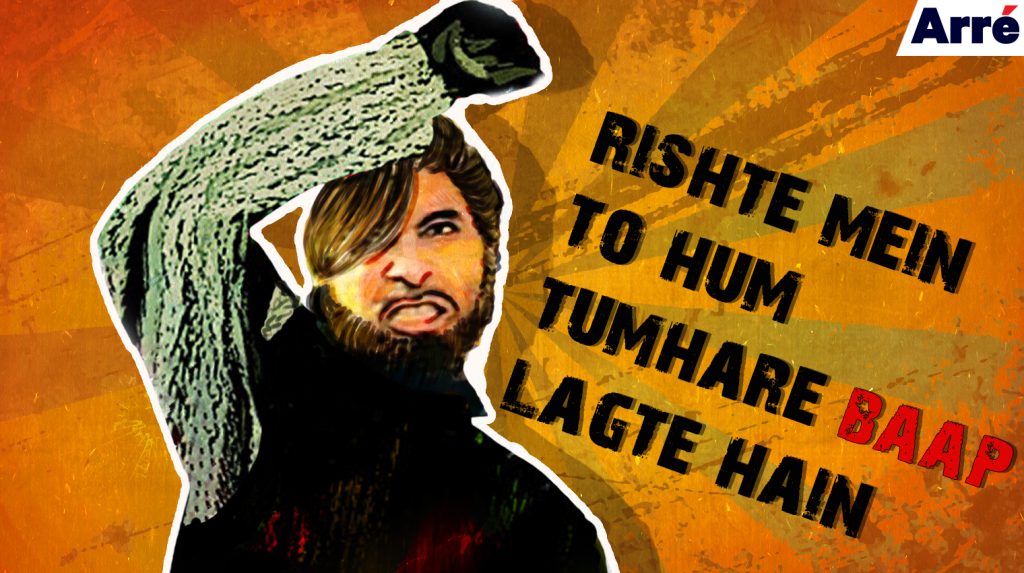

In 1988, three long years after he quit Bollywood and entered politics, Amitabh Bachchan, the OG angry young man, returned to the big bad world of movies. His comeback came on the back of a
vigilante goldmine that’ll go down in history for gifting the world two extraordinary pop-culture moments: a nocturnal avenger who wore the raddest costume ever, and a catchphrase that keeps on giving. “Rishte mein toh hum tumhare baap lagte hai, naam hai Shahenshah,” bellows Amitabh Bachchan, the eponymous hero in Tinu Anand’s Shahenshah, signalling the arrival of numerous blows on unsuspecting evil men. But over the years, the line has metastasised: It has become a conversation starter, found its way into parodies and memes. In the film – whose story comes from Jaya Bachchan herself – Vijay is a cowardly cop by day, and ruthless avenger by night, whose sole aim is to exact revenge for his honest cop father’s suicide twenty years ago after he was wrongfully framed for corruption. His chief target is crime baron and all-round creepster JK Verma, played to perfection by – who else? – the Black Dog-loving and bathrobe-wearing Amrish Puri. Besides being an amusing revenge drama, the film is marked by campy dialogue and the most insanely melodramatic courtroom scene in the history of courtroom scenes. Shahenshah starts off with a sneakily pertinent lesson: Never loan your friends money. Bank manager Mathur (Prem Chopra) learns it the hard way, when he loans JK 2.5 million rupees, naturally taken from the deposits of hardworking folks. The latter seems to be in no particular hurry to return it, leaving Mathur in a moral, financial, and personal dilemma. Being the kind-hearted crime baron that he is, JK suggests orchestrating a fake bank robbery to bail his friend out.In Shahenshah, Vijay is a cowardly cop by day, and ruthless avenger by night, whose sole aim is to exact revenge for his honest cop father’s suicide twenty years ago after he was wrongfully framed for corruption. Tinu Anand / Shiva Video
“Rishte mein toh hum tumhare baap lagte hai, naam hai Shahenshah,” bellows Amitabh Bachchan in Tinu Anand’s Shahenshah.It’s a matter of time before Vijay exploits his obsequious demeanour to get on JK’s payroll, who uses him to bypass the police and runs his underworld crime empire in peace. But he soon triggers Vijay into openly revealing his Shahenshah side to the world after he kills an innocent crime reporter who would bravely report on JK’s excesses. This is where we learn Shahenshah’s third lesson: Journalism is the real loser. It’s a prescient thought, that holds true even three decades later. And it leaves us with the most extra climax in the history of film climaxes. It starts with Inspector Vijay escorting a key witness, who has agreed to testify against JK by driving a car through the wall of the courtroom. But despite her testimony, JK is acquitted after a defence attorney pulls a rifle aimed at the judge (Extra level: unimaginable) forcing him to make a false confession in order to prove how easy it is to give one. This forces Vijay to channel his inner Shahenshah and chase JK to the roof of the courthouse. After making him admit to a litany of crimes, including his father’s suicide, Shahenshah lynches JK right in the middle of the courtroom after he falls through a hole in the roof. Before the whole court, JK is hanged with Shahenshah’s trustworthy noose and Vijay’s revenge is finally complete. My karma just ran over your dogma. So there we have it. More than three decades later, if you find yourself watching the entertainfest that is Shahenshah, and attempt to question its logic, remember that there are no wrong answers. There are only kickass ones. And not one of them is a patch on: “Rishte mein toh hum tumhare baap lagte hai.”