
S
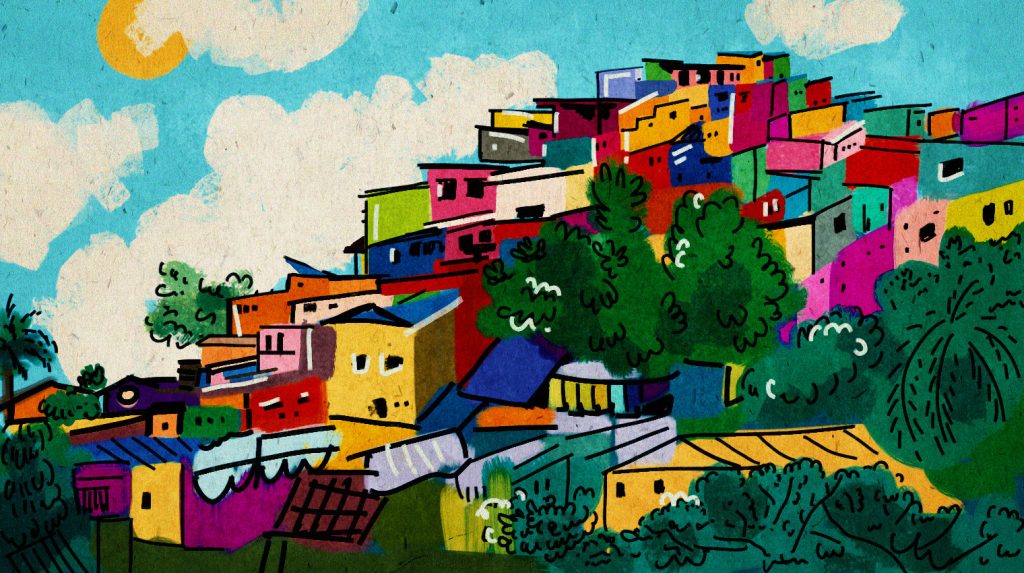
ince December last year, a new project in Mumbai has caused mild ripples online. As is the case with any urban beautification drive, the Chal Rang De team’s initiative to prettify the supposedly unattractive walls of Siddhivinayak slum in Asalpha, a neighbourhood in the Mumbai suburb Ghatkopar, has been followed with breathless – and unquestioning – excitement. The team has managed to change the area’s look by painting the walls of the squatter establishment. Viewed from the passing Metro train, it looks like a massive, vibrant Piet Mondrian canvas. The idea was fairly passable and the intent noble. It threw light over things that we’d rather not acknowledge in our banal daily routines. With the objective to “change the way people look at slums”, the Chal Rang De team unmasked the unuttered contempt privileged folks feel for urban slums and their inhabitants. To change people’s acrimonious perception of a slum, the team aimed to turn the slum into an “art gallery.” But here’s the thing. A slum is not an art gallery. But according to Dedeepya Reddy, the initiative’s founder, the Siddhivinayak slum, located on a hill, could be Mumbai’s future Positano. There are several problems with this baffling Hill Slum=Positano approach. The most obvious is that the only thing common between them is their sprawl up a slope. It’s like saying Mahabaleshwar is a lot like Monte Carlo because they are both pleasant during the summer. Giving the slum this aesthetic makeover is the literal definition of papering over its socio-economic conditions. It’s unlikely that Siddhivinayak will transform into a luxurious Italian destination in this lifetime, but I suppose one can be hopeful.
The Siddhivinayak slum has been around since the 1990s. Its grim reality is no different from that of Mumbai’s other slums. In this arrangement of alternating passages and lines of kholis, water run-off from washed vessels and clothes pools and stagnates in the middle of the lane; the insides of some of the kholis are pitch dark even during the day. Life here is tough as nails. But with a fresh coat of bright paint, this grim reality of 13 million Mumbaikars is now a pretty sight for Metro commuters. So, yay! Thanks to a growing interest in India, this romanticisation of slum life, that began with Slumdog Millionaire in 2008, is now a tourist attraction in the form of Dharavi Walks. What started as a chance for the rest of the city to try and understand slum-dwellers, previously only viewed as dirt-poor criminals, swiftly turned into “poverty tourism”. Yet, it was at least able to generate revenue for the people of Dharavi, by offering them a chance to show visitors around. But it is one thing to romanticise street life, and quite another to camouflage it in pretty colours and pretend that reality is all meadows and flowing brooks. Money is still hard to come by, safety is still an issue, hygiene is still non-existent, and higher education is a void. It is akin to telling someone wearing tattered clothes to doll up and play pretty just because you find it extremely awkward to look at rags amid riches. The Chal Rang De project isn’t the first in the world to have lost focus in the process. After a similar project with a similar intent of community transformation, artists Haas&Hahn beautifully explained in a TED talk, the plan they followed to paint Rio de Janeiro’s favelas (another word for a slum). They never talked about the social impact because there wasn’t any.Thanks to a growing interest in India, this romanticisation of slum life, that began with Slumdog Millionaire in 2008, is now a tourist attraction in the form of Dharavi Walks

Viewed from the passing Metro train, the beautification of Asalpha looks like a massive, vibrant Piet Mondrian canvas.
Image credit: Getty Images