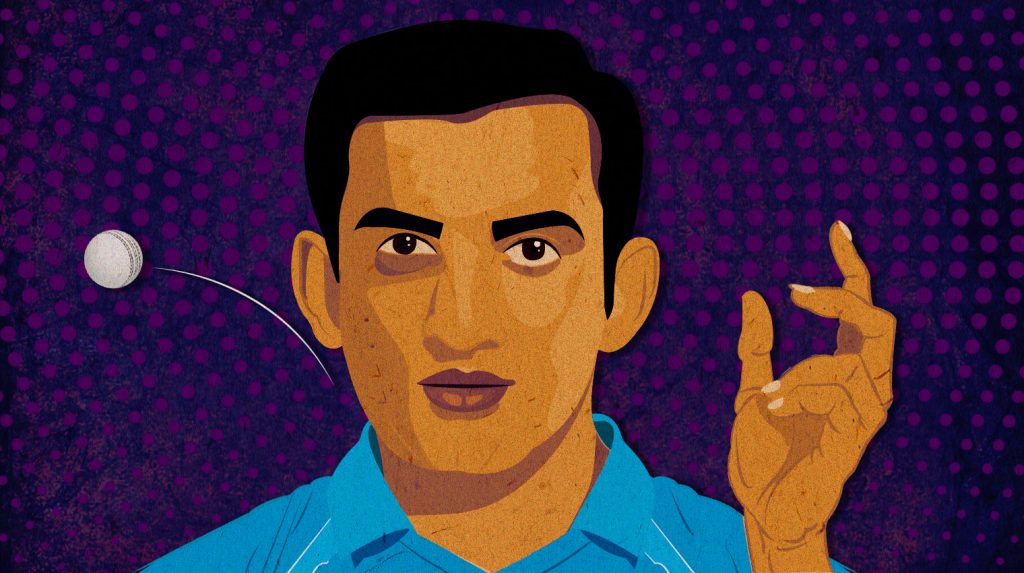

On a cloudy day in July, my eleventh-grade physics class was disrupted by rumours of Indian cricketer Gautam Gambhir coming to our school. Of course, my friends and I found our way to the basketball court. There, on a podium, in the middle of the court, with some media members and sixth graders forming the audience, Gautam Gambhir revealed the trophy for the first ICC World T20. Gambhir, still close with the cricket programme of his alma mater, Modern School, had recently replaced Virendra Sehwag as captain of the Delhi Daredevils, and had returned to his old stomping ground for his first major public appearance since the announcement. A rather routine, dull presser was followed by the excitement of a major scuffle. The kids in audience went loco for autographs in the pre-selfie era. There was a crowd of sixth graders and older girls chasing him to the parking lot. I stupidly tried to play the cool, distant type, but the rest hunted him down to his car, where he signed some Daredevils paraphernalia before being whisked away by Amit Mishra in a bottle-green Maruti Esteem. My sister managed to score an autograph, which she gave me. I put it in a drawer and forgot all about him, much like the country. *** Yesterday evening, the stoic southpaw called time on his 15-year-long career, retiring from all forms of cricket. He had been neglected by national selectors in recent years, and has always been the kind of player to know when his time at the crease is up. Declaring retirement on his own terms is an act of self-discipline one has come to expect from Gautam Gambhir, a man who has spent his entire playing career shining while the spotlight was directed somewhere else. When Gautam Gambhir debuted for India in 2003, he was a stylistically odd cookie – an opener who struggled to protect his off stump against fast bowling, but dominated spin bowlers. When it came to batting, his record was inconsistent. At times, he was a classicist with the decorative left-hand cover drive, but his authoritative pull shot showed aggressive, modernist tendencies. He was also a curious character, not visibly partaking in many team celebrations, showing little to no emotion, always operating in isolation, except for the now famous spat with Shahid Afridi in 2007, which became viral on YouTube and is aptly titled
Afridi vs Gautam Gambhir… full maa bhen.
India made 157 in the final against Pakistan in the ICC Twenty20 World Cup in 2007, and Gautam Gambhir made nearly half our runs.
Photo by Duif du Toit/Gallo Images/Getty Images
To this day, Gautam Gambhir remains the only Indian batsman in history to score over 300 runs in four consecutive seriesI first fell in love with Gautam Gambhir in early 2008, when India played Australia in Australia. The new and improved Gambhir was displaying the full gamut of his arsenal against the best in the world. We were chasing 317; Sachin went for 2, Sehwag for 17, Rohit for 1, Yuvraj for 5, but Gambhir was toying with the then famed Nathan Bracken, nudging for the ball, and took single after single unperturbed by the fall of wickets around him, finally comfortable in his isolation. He made 113 runs that day. We beat Australia in the finals of the CB Series 2-0 with a Sachin ton, and Praveen Kumar swinging the bejesus out of Ricky Ponting. Sachin casts a shadow larger than anyone in the sport, and this time it was even more special as we had won an ODI series in Australia for the first time. The unassuming Gambhir, the highest run-scorer in the series, was again forgotten.

Our Gambhir-blindness peaked in 2011, in the final of the World Cup in Mumbai.
Photo by Santosh Harhare/Hindustan Times via Getty Images