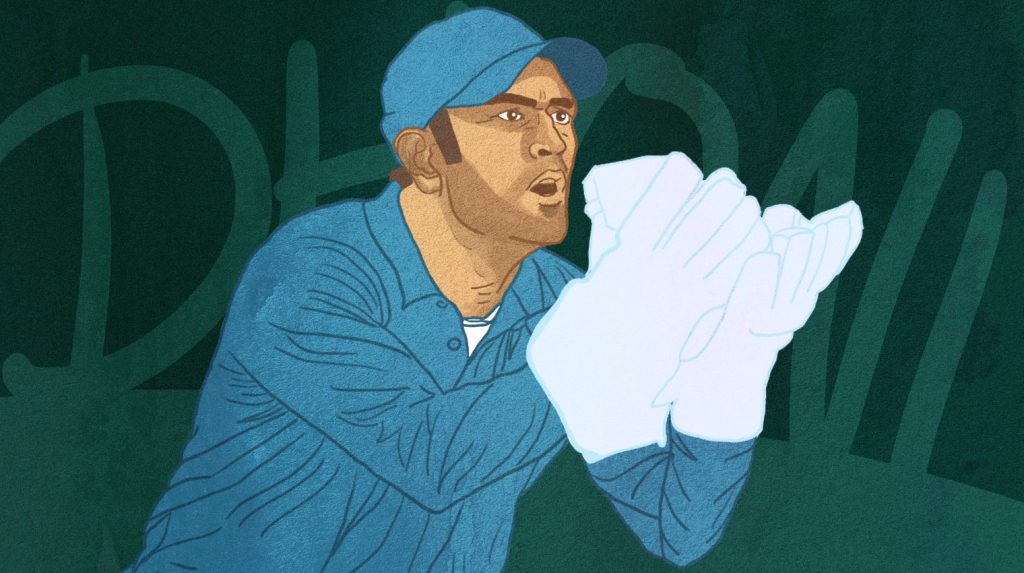

It’s
been a week of ups and downs in Indian cricket. While a Delhi boy “gedi-ied” his way onto the pitch in the middle of a Ranji Trophy match, New Zealand levelled the T20 series with an emphatic victory on a pitch as flat as Ranveer Singh’s abdomen. Nobody has had a more see-sawing week than Mahendra Singh Dhoni who lapped up applause when Nehra ji’s career breathed its last but was the subject of brickbats after he played an uncharacteristic innings in the second game, looking willfully distraught while he was at it. In the first match though, MS Dhoni played like the “Dhoni” we’ve all come to know, the man who can keep his cool under pressure. He stabilised a toppling top order and then took on the mantle of an able mentor when it came to taking decisions on the field that were out of Virat Kohli’s comprehension. He snuck in an unbeaten innings which seemed like a perfect throwback to the agricultural bat swinging mayhem from the early 2000s. The man, as the media reported, has matured like a rich, smoky single malt, and the icy countenance on his salt-pepper stubbled face suggests the same. MS Dhoni walked off the field unceremoniously in the second match of the series, with grey skies overhead, doing something that he’d almost never done – played out a painfully boring innings, where he looked like a fish out of water. Cricket is slowly becoming a young man’s game and nobody knows it better than Nehra ji and Dhoni. Watching Dhoni bat that evening was akin to slowly peeling a Band-Aid off a bruise and pinching it at the same time just to endure further pain. At least, that is what news establishments would like you to believe. “The end of Dhoni” and “Has Dhoni lost his Midas touch?” passed off for headlines soon after and the chakna commentators of Indian cricket spewed venom and caution in equal measure. But as always, we speak too soon. In his early days, when he swung the bat like an axe and murdered balls pitched at a good length, Dhoni unknowingly became the symbol of defiance that millions in small-town India dream of becoming some day. He became a Manmohan Desai hero on the pitch, who stood tall against a culture of urban privilege that ruled the sport. He was the voice of the marginalised, with blonde streaks of course. This is precisely the stuff films are made of, and rather ironically, he is perhaps one of the only few sportspersons who’ve had biopics made on them long before they retire.In sports, more than in films, the craft as it were, evolves faster than our players sometimes can cope with.Today, the aura of Dhoni is something that resembles that of Tendulkar’s toward the latter half of his career. There is reverence but also some sort of mob sentimentality against anybody who argues against him. Dhoni and his fans share a special bond of unquestioning faith we Indians reserve for babas, UPSC exams, and Smriti Irani. But fascist fanfare aside, sport in its essence is a great leveller, and longevity in sport is a matter of the mind over anything else, as a genius from the Alps called Federer would tell you. Across physically intensive sports such as athletics, tennis, or football, the eventual fatigue is an immediate realisation but the calamity that cricket has been cursed with, is its multiplicity of technicalities and departments. Chris Gayle can continue to bat like a boss even with a terrible back spasm only because his flamboyant game isn’t affected by the loss of his flexibility. As Nana Patekar says when he reprimands his son seeing him field in a game of gully cricket in Taxi No. 9211, “Bola tha na Tendulkar banne ka, Kaif nahin banne ka!” In a game comprising three varied disciplines, mastery in one is often more than enough when it comes to prolonging your career. Then calling time on a career is exactly like deciding to end a long overdrawn relationship – there is no right time to do so. In a country where films run for 25 years and soaps last for more than a thousand episodes, our actors need to keep up appearances until they eventually dismantle neatly into a pile of wrinkles and dust. Similarly, our cricketers are often made to play on well after they’ve crossed their expiry date. Kapil Dev played at least three more years after he’d passed his prime, just to get to the world record for the most accumulated wickets across formats. Our priorities might vary, but not spitting out a chewing gum until all that’s left of it is a ball of rubber and plaque, is still an innately Indian thing to do.

MS Dhoni played like the “Dhoni” we’ve all come to know, the man who can keep his cool under pressure. (Ashley Allen / Getty Images)