
A
bout 32 kilometres southwest of New Delhi lies
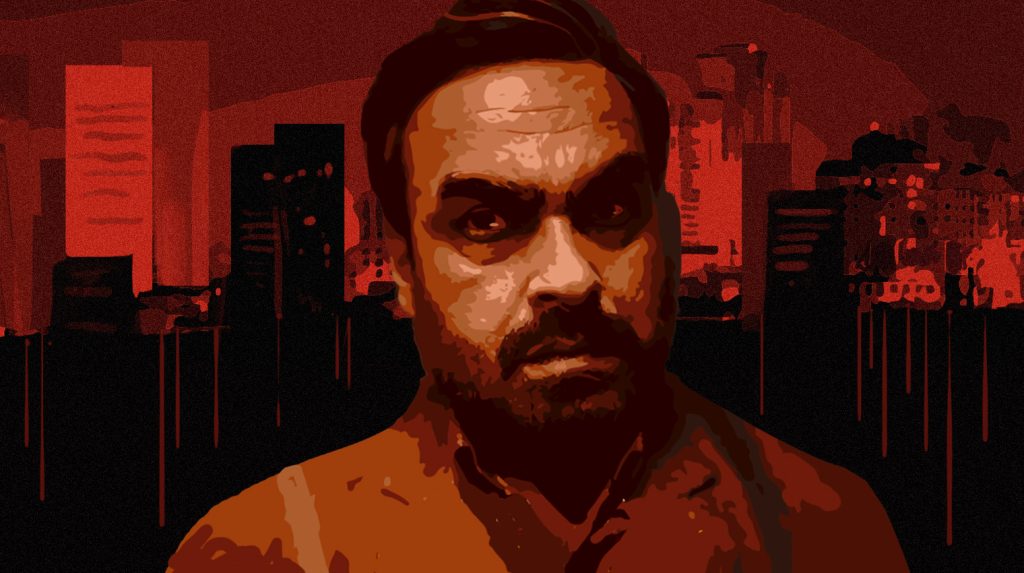
Gurgaon, the vibrant yet inorganic city that symbolises the epitome of achievement in newly affluent India. Yet, it’s a city straddling two Janus-faced mentalities. There is the Gurgaon of swanky skyscrapers, sprawling golf courses, and the third-largest per-capita income in India. And then there is the Gurgaon of casual violence and barely controlled aggression that hasn’t quite caught up with the 21st century. In his brooding directorial debut Gurgaon, National Award-winning cinematographer Shanker Raman, exploits this study in two halves. The contradictions of the “millennium city” act as a potent metaphor to emphasise the primal, predatory disposition lurking just beneath the surface of supposedly civilised men. The Singh family’s transformation closely mirrors that of their city. Just the way the village of Gurugram continues to thrive within the cosmopolis that came up seemingly overnight on vast tracts of agrarian soil, the Singh family were once superstitious rural landowners who turned into wealthy real-estate moguls. Shades of the violent men they were in the past, often overpower the progressive identities that they’ve carefully carved for their present, much to the detriment of the women in their lives. Kehri Singh (Pankaj Tripathi), the alcoholic patriarch of the family, is of the blind belief that the arrival of his adopted daughter Preet (Ragini Khanna) is the sole reason for the improvement of his family’s fortunes. As a result, every piece of land he owns is in her name, as is his real-estate business. This constant favouring fuels the inadequacy of his eldest son Nikki (Akshay Oberoi), resulting in his absolute disdain toward Preet, “picked from the rubbish heap”. In Nikki’s head, the road to earning his much delayed validation is interlinked with the urgent need to get his step-sister out of the way. He sets out to right the wrong the only way he can, and the only way he knows how to; through violence, an act that immediately transforms him into a shadow of his father, for whom, violence was a way of life.Kehri and Nikki’s eschewing of their civilised illusions, and morphing into the true beasts that they are inside, isn’t an exercise in isolation. It is in fact, the oldest refuge known to humans, incapable of restraint in high-intensity situations. Nikki, for instance, could seamlessly fit in with Pinky’s band of brothers in NH10, who take it upon themselves to exact a brand of murderous justice. This violence is spurred on by the assumption that they are the self-appointed protectors of honour. For Satbir, Pinky’s brother, slaughtering a girl is a rite of passage, a belief even more deep-set in his reproachful uncle, who admonishes him for using a gun instead of sticking to the traditional rod. Similarly, for Rahul and Shoumik, the father and step-father duo of Kali in Anurag Kashyap’s Ugly, the disappearance of their 10-year-old daughter draws out the literal ugliness of their personalities, whether it is the corrupt bureaucracy adopted by Shoumik, or Rahul’s manic-intensity fuelled by sheer helplessness. This ugliness remains hidden under layers of civilised behavioural codes, but as the film illustrates, it takes very little to unravel it. In that moment, when anger turns into brutality, violence is not just their release, but also a part of their identity.This ugliness remains hidden under layers of civilised behavioural codes, but as the film illustrates, it takes very little to unravel it.

Kehri Singh, the alcoholic patriarch of the family, is of the blind belief that the arrival of his adopted daughter Preet is the sole reason for the improvement of his family’s fortunes.
Image Credit / Jar Pictures